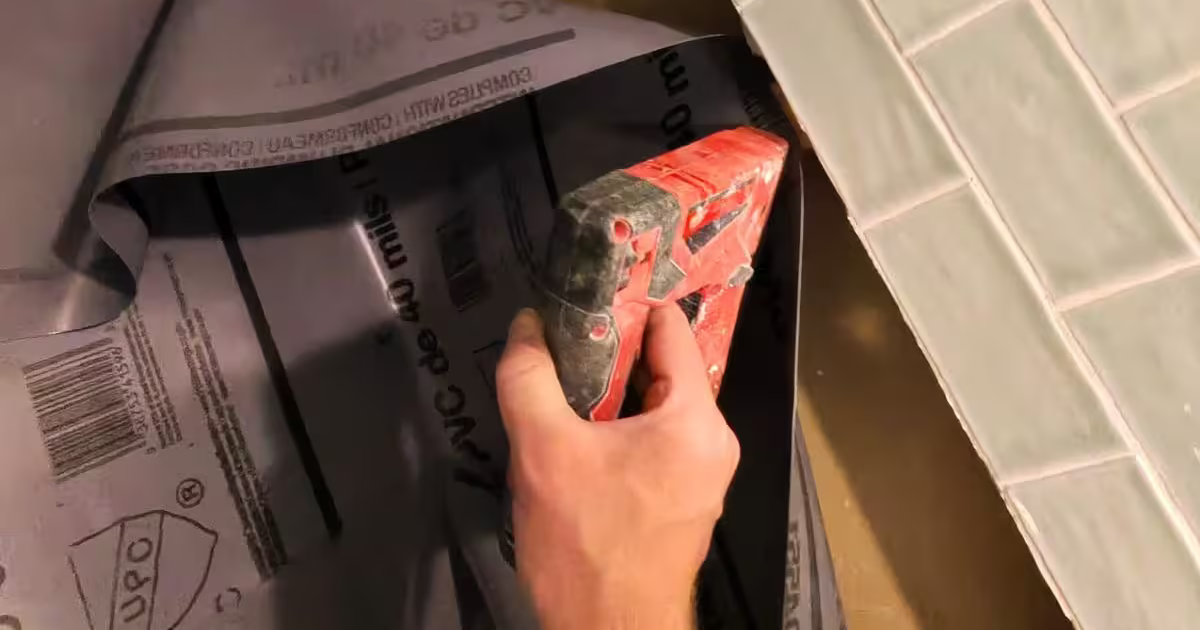
A finished tile shower looks sealed. Hard glazed tile, tight joints, a bead of caulk in the corners. It is easy to assume that surface is what keeps water out of the walls and the floor. It is not. The surface is there to look good and wear well. The waterproofing is a separate layer you will never see unless something goes wrong.
A tile shower is a system, not a surface
Here is what sits under your feet in a conventional tiled shower floor, from the top down:
| Layer | What it does | Is it waterproof? |
|---|---|---|
| Tile | Wear surface, appearance, slip resistance | Glazed porcelain is nearly impervious as a material. The assembly is not, because of the joints. |
| Grout | Fills joints, protects tile edges, keeps the surface cleanable | No. Cement grout is porous. Epoxy grout absorbs much less but is still a joint filler. |
| Thin-set mortar | Bonds tile to the bed or membrane | No. |
| Mortar bed (deck mud) | Creates the slope to the drain and supports the tile | No. It holds water like a sponge. |
| Liner or bonded membrane | Catches everything that came through the layers above and sends it to the drain | Yes. This is the waterproofing, and the only layer the code tests. |
| Pre-slope (liner systems) | Sloped mortar under the liner so the liner itself drains | No, but without it the liner cannot do its job. |
| Subfloor and joists | Structure | No. Wood that stays wet rots. |
On the walls the sequence is similar: tile, grout, thin-set, then either a waterproof membrane over cement board or foam board, or a vapor retarder behind the board. Regular drywall behind shower tile is a known failure point. Tim Carter's advice after a reader's wall collapse was simple: use cement board, which will not break down under constant moisture.
What the code calls the waterproofing
The International Residential Code does not mention tile or grout when it defines a watertight shower. It talks about the lining. Section P2709.2 of the 2021 IRC says shower floors and receptors must be lined, and lists what the lining can be made of: sheet lead, sheet copper, plastic liners (PVC to ASTM D4551 or CPE to ASTM D4068), hot-mopped asphalt, or sheet-applied load-bearing bonded waterproof membranes that comply with ANSI A118.10. A later subsection allows liquid-applied, trowel-applied A118.10 materials as well.
The same section sets the rules that make the lining work:
- The lining extends at least 2 inches above the finished threshold and 2 inches beyond or around the rough jambs. Some jurisdictions amend this to 3 inches. Either way, it has to be higher than any water that could stand in the pan.
- The lining is sloped 1/4 inch per foot to the weep holes in the drain. A liner laid flat on the subfloor holds water instead of shedding it.
- The lining may not be nailed or perforated at any point less than 1 inch above the finished threshold.
- An approved flanged drain is installed with the lining, with a watertight connection and weep holes into the drain.
- Where the shower is inspected, the liner is flood tested with 2 inches of water for at least 15 minutes before anything is built on top of it.

Porcelain absorbs almost nothing. The joints are another story.
Porcelain tile is fired dense enough that the material itself takes on very little water. That is not the weak point. A shower floor has dozens of feet of grout joint, and the walls have hundreds. Water moves through cement grout, runs behind the tile and ends up on whatever is under it. Ceramic Tile and Stone Consultants, who investigate failed installations, told one homeowner that the water at the bottom of their wall was traveling between the back of the tile and the substrate and evaporating out through the floor joint.
Corners and changes of plane
Where a wall meets the floor, or two walls meet, the surfaces move independently and rigid grout cracks. Industry practice is a flexible sealant meeting ASTM C920, usually 100 percent silicone over a backer rod, in every change of plane. The consultants above are direct that these joints should not have been grouted with a cementitious grout, and equally direct that sealant is a joint treatment that is "not meant to make the shower waterproof."
Penetrations
Every valve, shower arm, niche, bench, grab bar and glass-panel screw is a hole through the tile. The membrane has to be detailed around each one. Tile and grout cannot seal a screw hole from the top.
Two ways to build the waterproofing
Traditional: liner under the mortar bed
A sloped mortar pre-slope goes on the subfloor, the sheet liner goes over it and clamps into the drain, a second mortar bed goes on top of the liner, and the tile goes on that. Water that gets through the tile soaks into the top mortar bed, reaches the liner, and drains through the weep holes. It is a proven assembly with decades of history, and it is the one in most Denver-area showers built before the last ten or fifteen years.
Its weakness is that it depends on two things being right that nobody can see: the pre-slope and the weep holes. Fine Homebuilding's Tyler Grace, describing an inspector who wanted the liner laid flat, insists that a sloped mortar bed should be installed first, no matter what the inspector says, because if the liner is not pitched to the weep holes, the water has nowhere to go. A trade article in Pro Builder makes the same point from the other side: a mortar bed that stays wet invites efflorescence, grout discoloration, or mold growth.

Bonded membrane on top of the mortar
Systems such as Schluter KERDI, Laticrete Hydro Ban and similar products put the waterproofing on the top of the sloped mortar (or on a preformed foam tray) and bond the tile directly to it with thin-set. Water that gets through the grout runs on top of the membrane straight to a bonding-flange drain. The mortar underneath stays dry. Manufacturers describe this as a sealed assembly that can dry completely between uses; that is their framing, but it matches what we see when we open these showers up.
Both methods meet the code when the membrane meets ANSI A118.10 and the details are done right. Both fail when someone skips a step. We have replaced punctured liners and we have repaired bonded membranes with unsealed seams. Which one your shower has matters less than whether it was installed and tested properly.
Sealers, epoxy grout and 'waterproof' marketing
Grout sealer is a penetrating or film-forming product that reduces how fast cement grout absorbs water and stains. It wears off, it does nothing at cracks, and it does not reach the corners or the drain. Epoxy grout is a real upgrade for stain resistance and absorption, but in a case the consultants above reviewed, a shower that was regrouted with epoxy leaked again and the grout manufacturer told the homeowner the product is not a waterproofing material. Treat any product sold as "waterproof grout" the same way: a better surface, not a membrane.

What this means when your shower leaks
If water is showing up below or beside the shower, the surface is not where the fix is. The membrane has to be exposed, tested and either repaired or replaced. That is why our leaking shower and pan repair work starts with a flood test and the smallest opening that lets us see the liner, not with a grout bag. The companion article Why New Grout Won't Fix a Leaking Shower walks through the symptoms.
Not sure what is under your shower floor, or whether the leak is the pan or the wall? We can usually tell from a flood test and a small access opening, and we show you what we find before quoting the repair.
What to ask before anyone tiles a shower
Whether it is a new shower, a remodel or a repair, these questions separate a waterproofing job from a tile job:
- What is the waterproofing layer, by product name, and does it meet ANSI A118.10?
- Will the pan be flood tested before the mortar bed and tile go in, and can I see it holding water?
- How high does the liner or membrane run above the curb, and how is the curb itself wrapped?
- Is there a pre-slope under the liner (liner systems), or a sloped substrate under the membrane (bonded systems)?
- What is behind the wall tile: cement board, foam board, or drywall? What membrane or vapor retarder is on it?
- Are the corners and the wall-to-floor joint getting ASTM C920 silicone sealant instead of grout?
- How are the valve, shower arm, niche and glass fasteners sealed through the membrane?
For a new shower in Denver, this is the standard we build to on every shower remodel. For an existing shower that is failing, the answers tell you whether a targeted repair is realistic; see Shower Repair vs. Complete Rebuild.
Frequently asked questions
Is porcelain tile waterproof?
The tile body absorbs very little water, so as a material it is close to waterproof. A tiled surface is not, because water moves through the grout joints and at every corner and penetration. That is why a membrane is required under it.
My shower has no liner, just tile on cement board. Is that a problem?
Cement board is water resistant, not waterproof. Water will pass through it and the joints between sheets. A shower floor with no liner or membrane does not meet the code and will eventually wet the structure below. Walls without a membrane or vapor retarder behind the board are a common source of damp drywall in the next room.
Does a bonded membrane need a flood test too?
Yes. The code test applies to whatever lining is installed, and manufacturers of bonded systems describe a water test in their installation instructions. Seams and the drain connection are where bonded membranes fail, and a test finds those before the tile hides them.
How often should shower corners be re-sealed?
Whenever the sealant has pulled away, cracked or grown mold under it. There is no fixed interval. Cut the old sealant out completely and replace it with 100 percent silicone; do not run a new bead over the old one.
Sources and notes
- 2021 International Residential Code, Section P2709 Shower Receptors (UpCodes) — required lining, permitted materials (sheet lead, copper, PVC to ASTM D4551, CPE to ASTM D4068, hot-mop, ANSI A118.10 bonded membranes), 2-inch height above threshold, slope to weep holes, flanged drain.
- 2021 International Residential Code, Section P2503.6 Shower Liner Test (UpCodes)
- Pro Builder: Traditional Tiled Shower Construction vs. Bonded Waterproof Assemblies (Dec. 19, 2018) — mortar bed over a pan liner can stay wet; bonded assemblies keep water on top of the membrane.
- Tyler Grace, Fine Homebuilding: The Right Way to Install Shower Pan Liners — a sloped mortar bed belongs under the liner; a flat liner leaves water nowhere to go.
- Schluter-Systems: KERDI shower system and Shower System Installation Handbook — manufacturer description of the bonded (sealed) approach. Manufacturer literature, not independent testing.
- Tim Carter, Ask the Builder: Leaking Shower Pan – Membrane Failure — water passes through cement grout; use cement board, not drywall, behind shower tile.
- Ceramic Tile and Stone Consultants: Is it alright to use silicone sealant to fix a shower leak? — changes of plane get ASTM C920 sealant, not cement grout; sealant is not waterproofing.
- Ceramic Tile and Stone Consultants: Shower leaked again after regrouting with epoxy grout — the grout manufacturer told the homeowner the epoxy grout is not a waterproofing material.
Code references are to the model International Residential Code (IRC). Denver, Aurora, Parker and other metro jurisdictions adopt different editions with local amendments, so confirm requirements with your building division before relying on them. Last reviewed October 25, 2026.