A brown ring on the ceiling under the bathroom. A bubble in the drywall. A drip that shows up ten minutes into every shower. The first call most Denver homeowners make is to someone who will scrape out the old grout and put in new. It looks like the obvious fix, it is cheap, and it almost never works. Here is why.
What grout actually does
Standard grout is cement, sand and additives. It fills the gaps between tiles so the edges are protected, the surface is easy to clean and the installation looks finished. It is porous. Building expert Tim Carter puts it bluntly in his Ask the Builder column on shower pan failures: water passes through ceramic tile grout. A sealer slows that down. It does not turn the joint into a waterproof seam, and sealers wear off.
That is not a defect. Every properly built tile shower assumes water will get through the grout and plans for it. The tile is the wear surface. The waterproofing is a separate layer underneath that the code calls the shower lining.
Where the water is really getting out
Under the floor tile of a conventional shower there is a bed of mortar, and under that mortar is a sheet liner, usually PVC or CPE, clamped into a drain with weep holes. The International Residential Code (Section P2709) requires that liner, lists the materials it can be made of, and says it has to run at least 2 inches above the finished threshold and around the door jambs, slope toward the weep holes, and connect to a flanged drain with a watertight joint. Newer bonded membranes that meet ANSI A118.10 are also allowed; they sit on top of the mortar and the tile bonds directly to them.
Water that soaks through the grout is supposed to hit that liner, run down the slope and leave through the weep holes. When a ceiling below is wet, the water did not stop at the liner. As tile consultant Donato Pompo wrote in reply to a homeowner with water dripping into a basement, that means the pan was installed wrong or the waterproofing has failed, and replacing the caulking is unlikely to fix it.

New grout sits on top of all of this. It can make the surface shed water a little better for a few months, which is why some homeowners report that the leak "slowed down" after a regrout. The hole in the liner is still there. The next heavy shower finds it again.
Three places grout gets blamed
1. Cracked grout in the corners
Vertical corners and the joint where the walls meet the floor crack because the two surfaces move differently. Industry guidance is that these changes of plane should never be grouted with cement grout at all. Ceramic Tile and Stone Consultants tell homeowners the joints should have been filled with an ASTM C920 resilient sealant such as 100 percent silicone over a backer rod. Replacing cracked corner grout with sealant is correct maintenance. But the same consultants are clear that sealant is "not meant to make the shower waterproof," and that patching a corner on a leaking shower "is treating the symptom of the problem rather than fixing the problem."
2. Water appearing at the base of the wall
A wet line along the bottom row of tile, sometimes with white mineral staining, is a common complaint. In a case reviewed by the same consultants, the explanation was that water is traveling from behind the tile and evaporating through that joint. The water went in through grout joints higher up, ran down between the tile and the wall, and came out at the bottom. Regrouting the bottom row seals the exit, not the entrance, and pushes the water somewhere less visible.
3. The shower floor
Floor grout takes the most abuse and is the first thing people regrout. If the liner under the floor is sound, fresh floor grout is harmless and looks better. If the liner is punctured, the floor grout is irrelevant, because the water that matters is the water that already made it through the mortar bed.
When regrouting does help
We are not against grout work. Replace grout when:
- Joints are crumbling, stained or moldy, and there is no water showing up outside the shower.
- The corners were grouted instead of sealed. Cut the grout out and replace it with silicone sealant.
- A flood test of the pan held water with no loss, so you know the leak is surface water running out a door or over a curb.
Do not regrout as a first move when water is reaching a ceiling, a baseboard in the next room, or the subfloor. Trapped water keeps damaging framing while you wait to see whether the grout "worked." The EPA's guidance for any wet building material is that it should be dried within 24 to 48 hours to avoid mold growth. A shower that leaks a little at every use never gets that chance.
What we found in a Denver shower less than a year old
A homeowner in Denver called us about a second-floor shower that had been installed by another contractor roughly a year earlier and leaked from the first few uses. The wall tile was flawless. The grout was new. The ceiling below was sagging.
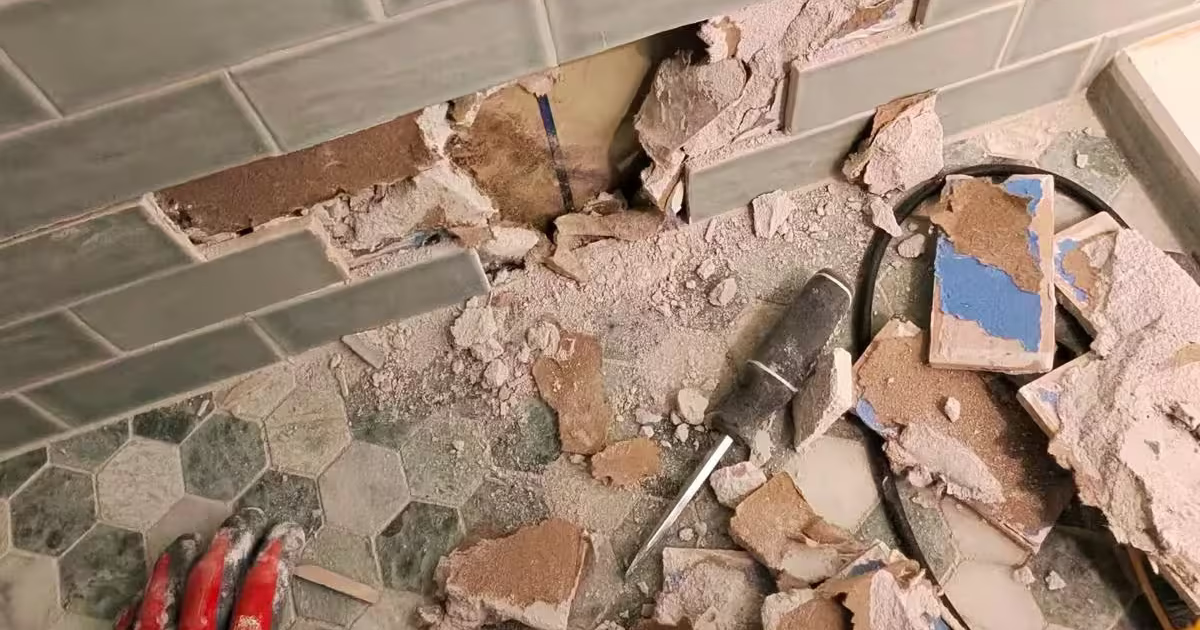
We opened the ceiling from below to confirm the water was coming from the pan area, then removed only the bottom four rows of wall tile and the mortar bed. In the corner of the pan, several screws had been driven straight through the PVC liner, below the level of the curb. The code is explicit on this point: the lining material shall not be nailed or perforated at any point less than 1 inch above the finished threshold. Every shower put water into those screw holes. No amount of grout above them could have changed that.

The fix was a new liner clamped into a new drain, a flood test, a new sloped mortar bed and new floor tile, with the bottom rows of wall tile reset to match. The full write-up is on our leaking shower and pan repair page.
How to tell which problem you have
| What you see | Most likely cause | Does new grout help? |
|---|---|---|
| Stain or drip on the ceiling below, during or right after showers | Liner or membrane failure in the pan, or the liner-to-drain connection | No. The liner has to be exposed and replaced or repaired. |
| Wet baseboard or carpet in the room behind the shower wall | Wall waterproofing missing or ended too low; a niche or valve penetration; a curb that was not wrapped | No. The wall assembly has to be opened at that spot. |
| Water on the bathroom floor outside the shower | Door or glass gaps, a curb sloped the wrong way, splash | Sometimes, if the curb grout line is the exit. Sealant at the glass and curb matters more. |
| Crumbling, discolored grout, no water showing up anywhere | Normal wear, hard water, grout mixed too wet | Yes. This is the job regrouting was made for. |
| Damp line along the bottom row of wall tile | Water running behind tile and exiting at the floor joint | Not on its own. Find where it is getting in; replace corner grout with sealant. |
The test that settles it
Plug the drain, fill the pan and watch. The IRC's inspection test for a new liner is 2 inches of water at the threshold held for at least 15 minutes with no evidence of leakage. On an existing shower with a known leak we hold the water for several hours, because small punctures can take time to show on the ceiling below. If the level drops or the ceiling gets wet with the shower valve off, the pan is the problem and grout is not the answer. If it holds, the leak is above the pan, which is a different and often smaller repair.
If water is reaching the ceiling or the next room, skip the regrout and start with a diagnosis. We open the smallest area that will show us the liner, flood test it, and tell you whether the pan can be replaced under the existing wall tile or the shower needs a rebuild.
Frequently asked questions
My contractor says the grout is the leak. Could they be right?
Only if the water is staying inside the shower or running out a door or curb. Water below the floor means the liner was bypassed. Ask them to flood test the pan before any grout work and to show you the result.
Will epoxy grout make my shower waterproof?
Epoxy grout absorbs far less water than cement grout and stains less. It is still a joint filler installed on top of the waterproofing, and it still cracks at corners that should have sealant. Grout manufacturers do not sell it as a waterproofing product. We cover this in Tile and Grout Are Not Waterproofing.
The leak only shows up sometimes. Is that still the pan?
Often, yes. A small puncture near the drain leaks only when the mortar bed around it is saturated, which depends on how long the shower runs. A puncture high on the liner leaks only when water pools above it. Intermittent is not the same as minor.
How long can I wait?
Framing that gets wet at every shower does not dry out between uses. In the Denver case above, the shower had leaked for well under a year and the framing already showed the start of rot. See What Causes a Shower Pan to Fail for the common failure points and Shower Repair vs. Complete Rebuild for how we decide what the fix should be.
Sources and notes
- 2021 International Residential Code, Section P2709 Shower Receptors (UpCodes) — lining materials, liner height above the threshold, slope to weep holes, and the rule against perforating the liner near the threshold.
- 2021 International Residential Code, Section P2503.6 Shower Liner Test (UpCodes) — 2 inches of water at the threshold for at least 15 minutes with no evidence of leakage.
- Tim Carter, Ask the Builder: Leaking Shower Pan – Membrane Failure — water passes through cement grout; leaks below the floor point to a membrane hole, bad installation, or separation from the drain.
- Ceramic Tile and Stone Consultants: Is it alright to use silicone sealant to fix a shower leak? — sealant at transition joints is maintenance, not waterproofing; patching the joint treats the symptom.
- Ceramic Tile and Stone Consultants: Why is water coming out of the grout on the side of our shower? — water travels behind tile and evaporates at the wall-to-floor joint; grout belongs in field joints, sealant at changes of plane.
- U.S. EPA, Mold Course Chapter 2 — wet materials should be dried within 24 to 48 hours to avoid mold growth.
Code references are to the model International Residential Code (IRC). Denver, Aurora, Parker and other metro jurisdictions adopt different editions with local amendments, so confirm requirements with your building division before relying on them. Last reviewed October 25, 2026.