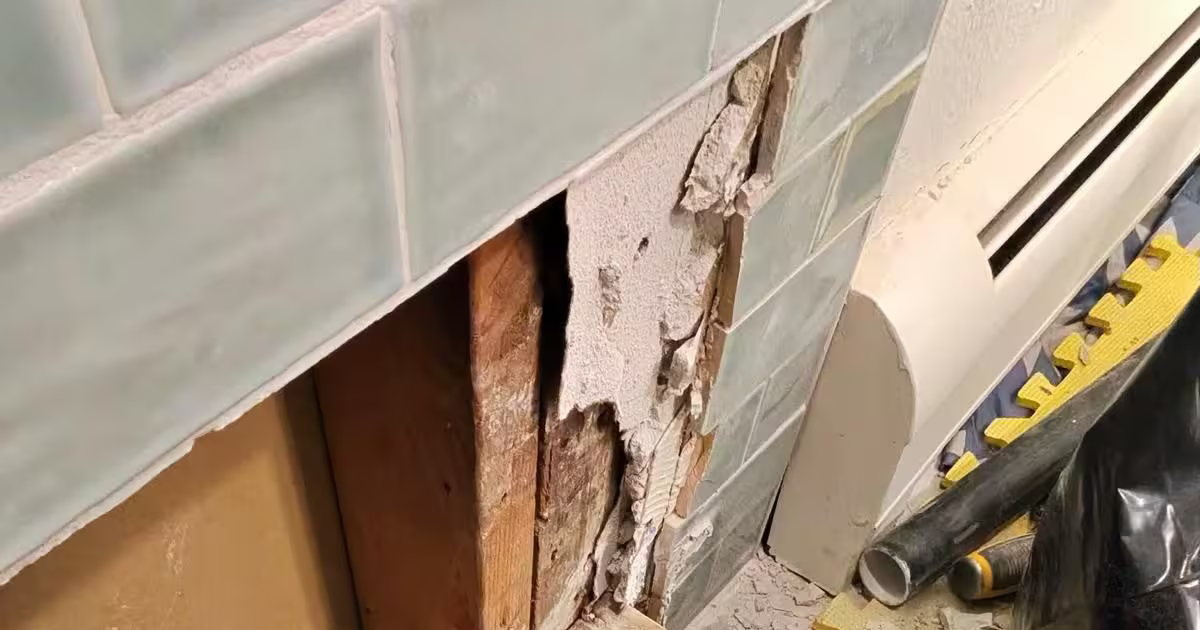
A shower pan is the one part of a bathroom that is supposed to hold water on purpose. When it fails, the water goes into the floor, the ceiling below, or the wall of the next room. We open these up for a living. The causes repeat, and almost all of them were built in on day one.
What a shower pan is
In a conventional tiled shower, "the pan" is not one thing. It is a sloped mortar pre-slope on the subfloor, a sheet liner (usually 40-mil PVC or CPE) laid over it and clamped into a two-piece drain, a second sloped mortar bed on top, and the floor tile. The liner is the waterproofing. The International Residential Code requires it to rise at least 2 inches above the finished threshold, slope 1/4 inch per foot to the weep holes in the drain, and stay free of nails or perforations within 1 inch of the threshold.
Newer showers may use a bonded membrane or a preformed foam tray instead, with the waterproofing on top of the mortar and the tile bonded directly to it. Those fail in fewer ways, but the ways they fail are on this list too.
1. Fasteners driven through the liner
This is the failure we found in a second-floor Denver shower that had leaked from its first few uses. Behind the bottom rows of wall tile, in the corner of the pan, several screws had been driven straight through the PVC liner below the curb line. Each one was a direct path from the mortar bed into the floor framing. Fine Homebuilding's Tyler Grace flags the same risk from metal lath laid over a liner, risking possible puncture. Common culprits: backer-board screws set too low, curb framing screwed from the inside, a grab bar or glass channel anchored into the pan area, or a drain strainer screw that missed the flange.
How it shows up: leaking from the first weeks of use; a drip on the ceiling below every time the shower runs; wall tile and grout in perfect condition.
Fix: replace the liner. A puncture low in the pan is under the mortar bed and cannot be patched from above. Tim Carter notes a solvent-welded patch is realistic only when the hole is in the membrane above the floor.

2. No pre-slope under the liner
The liner must be pitched to the drain so the water that reaches it leaves. Installers who lay the liner flat on the subfloor and build the slope only in the top mortar bed create a shallow pool under the shower. The mortar bed above it stays wet, and the water sits at the lowest point of a liner that has no low point. Grace calls the flat-liner method flawed and is direct about the remedy: a sloped mortar bed should be installed first, no matter what the inspector says.
How it shows up: no dramatic leak, but floor grout that darkens and will not stay clean, a musty smell, white efflorescence at the base of the walls, mold in the lowest joints. A trade article in Pro Builder lists exactly these outcomes for a mortar bed that stays wet: efflorescence, grout discoloration, or mold growth. Over years the saturated bed weakens; Grace warns it can weaken "to the point of failure."
Fix: the pan has to come out to the subfloor and be rebuilt with a pre-slope, or be replaced with a bonded-membrane or foam-tray assembly where the slope is built into the substrate. Nothing applied to the tile addresses it. Our article on shower floor slope requirements explains the two-slope rule in detail.

3. Weep holes buried or clogged
A clamping drain has small holes in the flange that let water on top of the liner into the drain. If the installer packs mortar straight against the drain, the holes fill with cement and the liner has no outlet even if it is sloped. Over time the holes can also clog with the minerals in Denver's hard water and with soap residue that migrates through the bed. The code requires the weep holes to exist; it is up to the installer to keep them open with pea gravel, tile spacers or a drainage mat around the drain.
How it shows up: the same slow symptoms as a missing pre-slope. A sealed mortar bed holds water indefinitely.
Fix: in a few cases the holes can be cleared through the drain. Usually they cannot, and the drain and liner are replaced together.
4. The liner stops too low or skips the curb
The liner has to run up the walls above the threshold, wrap over the curb and around the door jambs. The code minimum is 2 inches above the finished threshold; local amendments and good practice often go higher. We see liners cut flush with the top of the first course of tile, curbs with a liner on the inside face only, and jambs with no liner at all. Water that stands in the pan during a long shower, or that pools when the drain is slow, rises above the liner and goes into the wall.
How it shows up: damp drywall or baseboard on the other side of the curb or the shower wall; a leak that appears only after long showers or when the drain is partially clogged; damage at the door side of the shower.
Fix: depends on where it stops short. A curb can sometimes be rebuilt and re-wrapped on its own. A liner that is low on every wall means a new pan.

5. A bad connection at the drain
The liner is clamped between the drain's base flange and a ring that bolts down over it. If the liner was not cut cleanly around the drain, if the bolts were left loose, if sealant was skipped under the liner, or if the drain body sits proud of the pre-slope so the liner bridges over a gap, water goes down the outside of the drain instead of through it. Carter's list of the three causes of a leaking pan ends with a membrane that has separated from the drain pipe. Bonded systems have the same weak spot at the membrane-to-flange bond.
How it shows up: a drip directly below the drain, often visible from a basement or a ceiling opening; a leak that starts within minutes of turning the water on.
Fix: the mortar bed around the drain has to be removed to reach the clamping ring. In practice that means a new liner, because an old liner rarely survives having the bed chipped off it.
6. Corners folded badly or seams not welded
A sheet liner is one piece folded into the corners, never cut. Where a seam is unavoidable, the code requires PVC seams to be solvent-welded per the manufacturer's instructions. We find corners that were slit and "fixed" with a dab of caulk, patches that were laid on dry, and outside corners at the curb that were never closed. In bonded systems the equivalent is a membrane seam with too little overlap or a corner piece that was not embedded.
How it shows up: leaks at one corner of the ceiling below; a leak that appears only when water is directed at a specific wall.
Fix: a new liner, or in a bonded system a properly embedded corner and a re-test.
7. Nobody flood tested it
Every one of the failures above is caught by one test: plug the drain, fill the pan, wait. The code inspection standard is 2 inches of water held for at least 15 minutes with no evidence of leakage; most professionals hold it longer. In the Denver shower above there was no sign a test had ever been done. Screws through a liner would have shown up on the ceiling within the hour. If a contractor does not flood test, they are not finding their own mistakes, and the homeowner finds them later.
Matching the symptom to the cause
| Symptom | Most likely causes | What has to be opened |
|---|---|---|
| Drip on the ceiling below every shower, started early in the shower's life | Fasteners through the liner (1), drain connection (5), bad corner or seam (6) | Ceiling below for confirmation; bottom rows of wall tile and the mortar bed |
| Grout that darkens, musty smell, white staining at the wall base, mold in low joints | No pre-slope (2), clogged weep holes (3) | The whole pan, to the subfloor |
| Damp wall or baseboard outside the shower, worse after long showers | Liner too low or curb not wrapped (4) | The curb and the affected wall from the back or the inside |
| Leak only at one corner of the ceiling below | Corner fold or seam (6), fastener (1) | That corner of the pan |
| Water appears with the valve off, hours later | Water trapped in a flat liner (2) slowly finding a hole | The pan |
Wet framing is the hidden cost in every row. The EPA's standard for any wet building material is to dry it within 24 to 48 hours to prevent mold. A pan that leaks at every use keeps the joists wet permanently. In the Denver shower, caught within a year, the floor framing already showed early rot at the corner and the ceiling drywall below had to be replaced.
Can a failed pan be fixed without rebuilding the shower?
Sometimes. If the wall waterproofing is intact, the framing is sound and the leak is confirmed in the pan, the liner can be replaced under the existing wall tile: remove the floor tile and mortar bed and the bottom few rows of wall tile, install a new liner and drain, flood test, rebuild the bed, re-tile the floor and reset the bottom rows. That is what we did in Denver. If the walls were built on drywall, the liner is low everywhere, or the framing has rot beyond a few inches, the honest answer is a rebuild. How we make that call is the subject of Shower Repair vs. Complete Rebuild.
What never works is treating the surface. See Why New Grout Won't Fix a Leaking Shower.
If your shower matches any row in that table, we can confirm the cause with a flood test and a small access opening, and tell you whether a pan replacement under the existing tile is realistic.
Frequently asked questions
How long should a shower pan last?
A correctly built and tested liner pan has no fixed lifespan and can outlast the tile on top of it. We do not quote a number of years because the pans we replace are not failing from age; they are failing from one of the causes above, sometimes within months.
Can I see the pan without demolition?
No. The liner is under the mortar bed and behind the wall tile. What you can do without demolition is a flood test, which tells you whether the pan holds water, and an inspection from below if there is a basement or an accessible ceiling.
Is a preformed foam tray better than a mortar pan?
It removes the pre-slope and weep-hole failures (2 and 3) because the slope is molded in and the waterproofing sits on top. It still depends on the drain bond, the seams and the flood test. A foam tray installed without a test is no safer than a liner installed without one.
My shower is leaking but the pan tests fine. What then?
Then the leak is above the pan: the wall membrane, a niche, the valve, a bench, the door, or the curb top. Those are often smaller repairs. Do not let anyone replace a pan that passed its flood test.
Sources and notes
- 2021 International Residential Code, Section P2709 Shower Receptors (UpCodes) — lining height (2 inches above threshold), slope to weep holes, no perforation within 1 inch of the threshold, solvent-welded PVC seams, flanged drain with weep holes.
- 2021 International Residential Code, Section P2503.6 Shower Liner Test (UpCodes)
- Tyler Grace, Fine Homebuilding: The Right Way to Install Shower Pan Liners — pre-slope under the liner; saturated mortar bed weakens to failure; puncture risk from lath over the liner.
- Pro Builder: Traditional Tiled Shower Construction vs. Bonded Waterproof Assemblies (Dec. 19, 2018) — wet mortar bed leads to efflorescence, grout discoloration or mold; cement board is water-resistant, not waterproof.
- Tim Carter, Ask the Builder: Leaking Shower Pan – Membrane Failure — membrane with a hole, installed wrong, or separated from the drain; patching is possible only above the floor.
- U.S. EPA, Mold Course Chapter 2 — dry wet materials within 24 to 48 hours; controlling moisture controls mold.
- South Denver Tile Experts: Leaking shower and pan repair, Denver (project record) — the second-floor Denver shower referenced in this article.
Code references are to the model International Residential Code (IRC). Denver, Aurora, Parker and other metro jurisdictions adopt different editions with local amendments, so confirm requirements with your building division before relying on them. Last reviewed October 25, 2026.