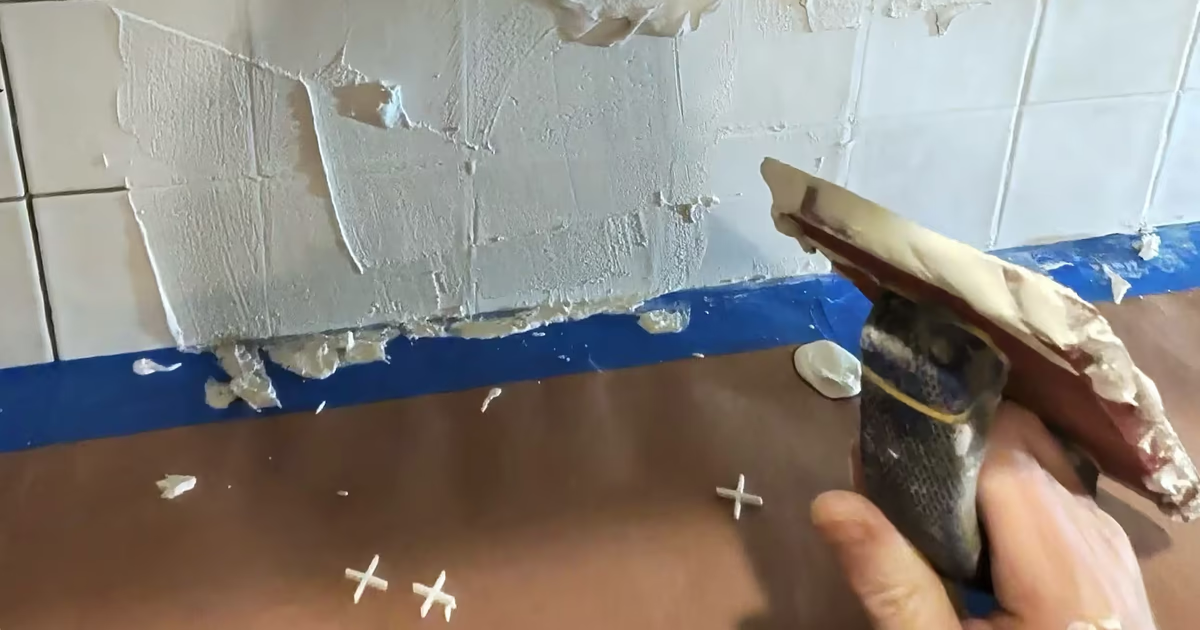
Every shower quote names a grout, and most homeowners sign without knowing what the name means. There are three families: cement grout you mix with water, two-part epoxy, and the premixed pails sold as single-component or ready-to-use grout. They differ in stain resistance, cleanup, how long you wait before the first shower, and whether they ever need sealing. Here is what the standards and the manufacturers' own data sheets say about each, and how we choose.
The three families and their ANSI classes
Grout in the United States is specified against American National Standards written for the tile industry. The classes matter because they tell you what a product was tested to do, not just what the bag says. The Sika grout guide and a Construction Specifier article by a Custom Building Products representative lay the categories out the same way, and the data sheets we read confirm them:
| Family | ANSI standard | What it is | Examples from the data sheets we read |
|---|---|---|---|
| Standard cement grout | A118.6 | Portland cement, sand (or none), dry polymer. Mixed with water on site. | Polyblend Plus is listed as exceeding A118.6 and A118.7 |
| High-performance cement grout | A118.7 | Cement grout tested to tighter limits: shrinkage under 0.20%, water absorption under 5%, compressive strength over 3,000 psi at 28 days. Often calcium aluminate cement, but Portland formulas qualify too. | Custom Prism, Custom Polyblend Plus, LATICRETE PERMACOLOR Select |
| Epoxy grout | A118.3 | Two-part epoxy resin and hardener with a colored aggregate. Chemical resistant and water cleanable while fresh. | LATICRETE SPECTRALOCK PRO Premium, MAPEI Kerapoxy CQ |
| Premixed (single-component) grout | A118.19, where claimed | A factory mixture of water, polymers, aggregate and pigment. No Portland cement. Cures by evaporation. | MAPEI Flexcolor CQ claims A118.19; Custom Fusion Pro's sheet says it 'meets many of the performance characteristics' of A118.7 and A118.3 without claiming either |
Two things in that table deserve a closer look. First, A118.7 is a performance class, not a chemistry. Custom's Polyblend Plus is a Portland cement grout that meets it; Custom's Prism is a calcium aluminate grout that meets it. Second, "premixed" is the least regulated label of the three. A118.19 is a recent standard for organic premixed grout, and MAPEI's Flexcolor CQ sheet claims it, but the Fusion Pro sheet we read does not claim conformance to any ANSI grout standard. That is not a knock on the product; it means you compare premixed grouts on their own published limits rather than on a class label.
Sanded, unsanded and joint width
The sanded-versus-unsanded question is older than any of the standards and still trips people up. Sand gives cement grout body so it does not shrink and crack in a wide joint; it also scratches soft surfaces. The industry rule, repeated by Fine Homebuilding and Sika's guide, is unsanded grout for joints under 1/8 inch and for polished marble or glass, sanded for 1/8 inch and wider. Polyblend Plus Sanded is rated for 1/8 to 1/2 inch joints; its sheet points to the unsanded version for joints up to 1/8 inch.
Three details from the data sheets complicate the simple rule:
- Most epoxy grout is sanded too. SPECTRALOCK PRO Premium is rated for 1/16 to 1/2 inch joints but its sheet warns that in joints under 1/8 inch the surface will look coarser, and that soft polished marble or delicate glazed and glass tile might be scratched during installation. Kerapoxy CQ carries the same caution and tops out at 3/8 inch.
- Premixed grouts use a rounded filler rather than angular sand, which is why Fusion Pro and Flexcolor CQ are both rated from 1/16 to 1/2 inch, and both sheets still say to test glass mosaic and marble first.
- There is now an unsanded cement grout that meets A118.7: LATICRETE's PERMACOLOR Select NS, which its sheet rates for joints up to 1/2 inch between polished marble, soft glass, glazed wall tile and porcelain. That closes the old gap where a polished stone shower had to accept a weaker grout.
Whatever family you choose, the test patch matters. Every one of these sheets says to grout a small area first and check for scratching and staining before committing to the whole shower.
Stains, water absorption, color and sealing
This is where the families separate. Cement grout is porous: the A118.7 class caps water absorption at 5 percent, and standard A118.6 grout is more open than that. Sika's guide says cement grout is "recommended to seal due to its high porosity," with sealer reapplied every two to three years; Fine Homebuilding's Tom Meehan puts it as "cement-grouted joints require grout sealer, but epoxy-grouted joints don't."
The A118.7 products soften that rule without erasing it. Prism's sheet says "no sealer required," then recommends a water-based sealer "when enhanced stain protection is desired," applied after 48 hours; Polyblend Plus calls sealing optional "for extra protection"; PERMACOLOR Select NS says to wait 72 hours if you do seal. In other words, an A118.7 grout holds up unsealed and holds up better sealed. In a daily-use shower with light grout, we treat the sealer as part of the job.
Epoxy and premixed grouts do not absorb water the way cement does. SPECTRALOCK PRO Premium "never needs sealing" and is "stainproof" to common household goods in residential installations, with the caveat printed beside it: clean all spills immediately. Kerapoxy CQ needs no sealer and is "highly resistant to staining," with the same caveat about long-term exposure. Fusion Pro is sold as "stain proof" with "no sealing required," and its sheet forbids solvent-based sealers or enhancers on it. Flexcolor CQ needs no sealer and relies on surface "water repellency" against water-based stains.
Color consistency and efflorescence
Cement grout changes color as it hydrates, not always evenly. Sika's guide lists over-watering, sunlight and air movement as causes of blotchy curing; Polyblend Plus's sheet adds tile porosity, climate and cleanup water. Efflorescence, the white mineral bloom on cement products, is the other cement-only problem, and here the newer chemistries win: Prism "will not effloresce," Polyblend Plus claims "better resistance to efflorescence," and Kerapoxy CQ and Flexcolor CQ state they do not contribute to it. Premixed grout contains no Portland cement, so it has nothing to effloresce.
Epoxy has its own color risks. Both epoxy sheets warn that propane jobsite heaters can yellow the grout, that colors shift under UV outdoors, and that the resin can stain white or porous marble; MAPEI says "do not use for grouting white or translucent marble." If your shower is Carrara or Thassos, that line changes the decision.
Workability, haze and cleanup
The reason many installers still reach for cement grout has little to do with performance. Cement grout is forgiving. Polyblend Plus gives you about 30 minutes after the grout firms to clean a section, haze comes off with cheesecloth after 3 hours, and if haze persists the sheet allows an alkaline scrub after three days or a sulfamic acid cleaner after ten. Meehan's summary is that cement residue "can be buffed off tile the day after it's applied."

Epoxy is the opposite. SPECTRALOCK PRO Premium lists 80 minutes of working time at 70°F and 30 minutes at 95°F. Kerapoxy CQ's pot life is 45 to 60 minutes, and because it is thermosetting it "sets up faster in a container or in a large mass," so the sheet says to work from small piles, clean after every unit, and finish the final wash within 15 to 20 minutes. Then the line that matters for homeowners: Kerapoxy CQ "is extremely difficult to remove once cured." If a crew leaves a film on the tile overnight, the fix is a dedicated haze remover and patience, which is why we wrote a separate guide to epoxy grout haze removal.
Premixed grout is fast in a different way. Fusion Pro's sheet says to spread for only 1 to 4 minutes, roughly 10 square feet, before cleaning, and warns not to clean it "as typically done with cement or epoxy grout." Flexcolor CQ wants cleaning to start within 5 to 10 minutes, once the surface skins over, and tells you to change the rinse water often to avoid a haze. Both cure by evaporation, so low temperatures and high humidity stretch the cure, and Fusion Pro's sheet notes that covering it immediately after grouting slows it further.
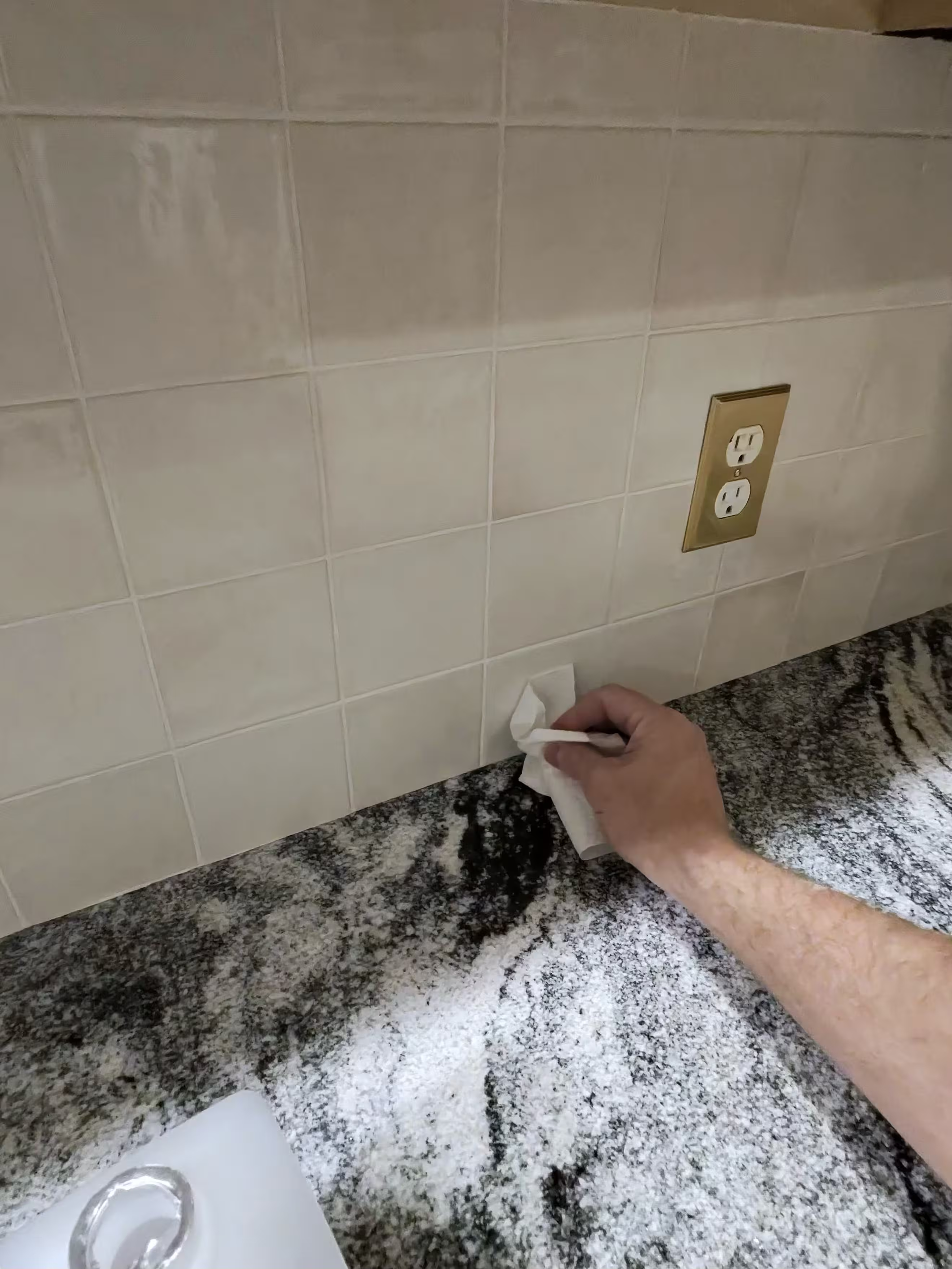
Cure times: when can you use the shower?
"Wait 24 hours" is a habit, not a specification. The real numbers are printed in each data sheet and they are not the same across families, or even within one. All of the figures below are at roughly 70 to 73°F; every sheet says cooler temperatures or higher humidity extend them, which matters in a Denver basement bathroom in January.
| Product (class) | Light foot traffic | Intermittent water (a shower) | Steam room or submerged | Full cure / stain protection |
|---|---|---|---|---|
| Polyblend Plus Sanded (A118.6/A118.7) | 16 hours | Not stated on the sheet | 14 days before full submersion | Not stated |
| Prism (A118.7) | 4 hours | 3 days | 14 days before filling with water | Seal after 48 hours if sealing |
| PERMACOLOR Select NS (A118.7) | Not stated | Not stated | 14 days | Seal after 72 hours if sealing |
| SPECTRALOCK PRO Premium (A118.3 epoxy) | 12 hours (heavy traffic 24) | Not stated separately | 10 days | Stain protection 7 days; full cure 14 days |
| Kerapoxy CQ (A118.3 epoxy) | 24 hours (heavy traffic 48) | Not stated separately | 10 to 14 days before immersion | Full cure 14 days |
| Fusion Pro (premixed) | 24 hours | 7 days at 70°F and 50% RH | Not permitted | Not stated |
| Flexcolor CQ (A118.19 premixed) | 24 hours | 3 days | Not permitted | Full cure 3 days |
Notice that neither epoxy sheet gives a separate "first shower" number. SPECTRALOCK lists 7 days to full stain protection and 10 before steam or submersion; Kerapoxy lists 10 to 14 days before immersion and a 14-day full cure. We schedule the first shower after the stain-protection window, not before, because a soap bottle left on a bench on day three is exactly the exposure the sheets warn about. For premixed grout the spread is wide: Flexcolor CQ allows intermittent water at 3 days, Fusion Pro requires 7. Ask which product went in, read its sheet, and get the date in writing.
Where grout must never be used
The most common grout failure in a shower is not the grout family. It is grout where there should be sealant. Every change of plane, wall to wall, wall to floor, tile to tub, tile to countertop, is a joint between surfaces that move independently. The industry reference is TCNA Handbook Method EJ171, and the NTCA technical team writing in TileLetter is direct: "The best type of material for these types of joints is a flexible sealant that meets the ASTM C920 rating." Sika's guide lists the C920 classes that apply (Type S or M, Grade P or NS, Class 25 or 12.5) and a Shore hardness of at least 35 where the joint is walked on.
The grout manufacturers agree. Polyblend Plus's sheet says movement joints "are required for perimeters and other changes of plane in all installations" and cites EJ171. Prism and Fusion Pro carry the limitation "not for use in movement joints or changes of plane" and point to a 100 percent silicone sealant instead; Custom's commercial silicone is listed as conforming to ASTM C920 and meeting EJ171 for "coves, corners, changes in plane and expansion joints." Epoxy gets no exemption: it is more rigid than cement grout, so a corner filled with it is more likely to crack, not less.
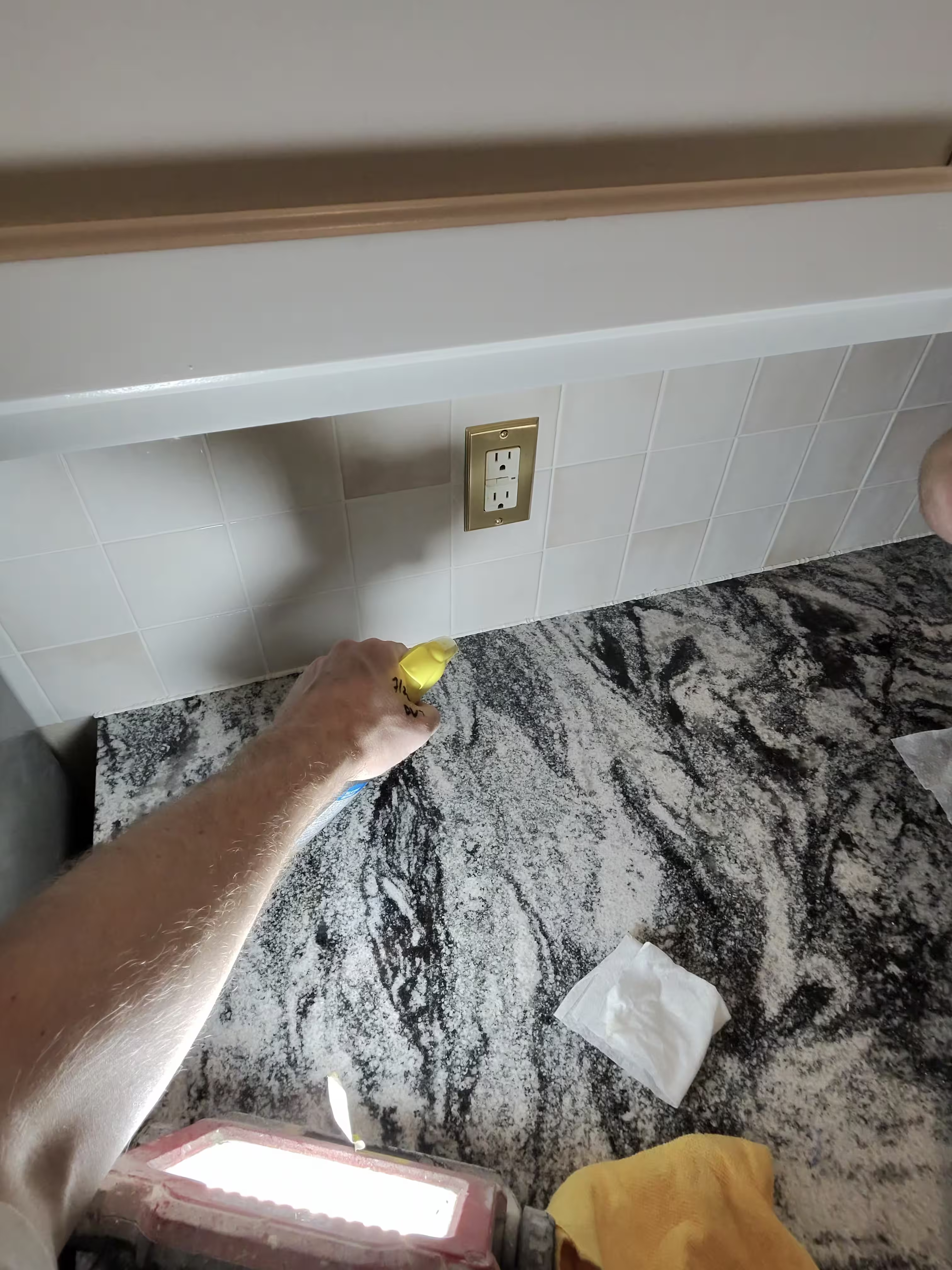
The second place grout does not belong is in the role of waterproofing. TCNA's steam room FAQ says it in one sentence: "While glazed tile is vapor impermeable, the grout is not. In fact, cementitious grout easily transmits water and vapor." The epoxy sheets agree about their own product: LATICRETE prints "epoxy grout for ceramic tile and stone is not a replacement for a waterproofing membrane," and the PERMACOLOR sheet repeats it for cement grout. A stain-proof grout keeps the joint looking clean; the membrane behind the tile keeps the water in the shower. We cover why in Tile and Grout Are Not Waterproofing and Why New Grout Won't Fix a Leaking Shower. If a shower is leaking, switching to epoxy grout is not the repair.
Steam showers and heated floors
A steam shower is the one residential room where the grout decision is partly made for you. The TCNA FAQ points to Handbook methods SR613 and SR614 and to a waterproof membrane meeting ANSI A118.10, and reminds you that vapor passes through grout. The grout has to tolerate heat and constant humidity, and the premixed family excludes itself: Fusion Pro's sheet says "not for use in steam rooms or submerged applications," Flexcolor CQ is "not recommended for installation in steam rooms or saunas" and not for areas hotter than 125°F, and the Construction Specifier article caps premixed grout at steam showers below 160°F. Cement and epoxy are permitted with longer cures: PERMACOLOR Select NS wants 14 days before a steam room is used, SPECTRALOCK PRO Premium 10. Kerapoxy CQ resists 212°F once cured and asks you to keep a steam-cleaning wand 6 to 12 inches off the surface, while SPECTRALOCK's sheet excludes "aggressive cleaning regimens (e.g. steam cleaning)," a reminder that two A118.3 products can carry different limitations.
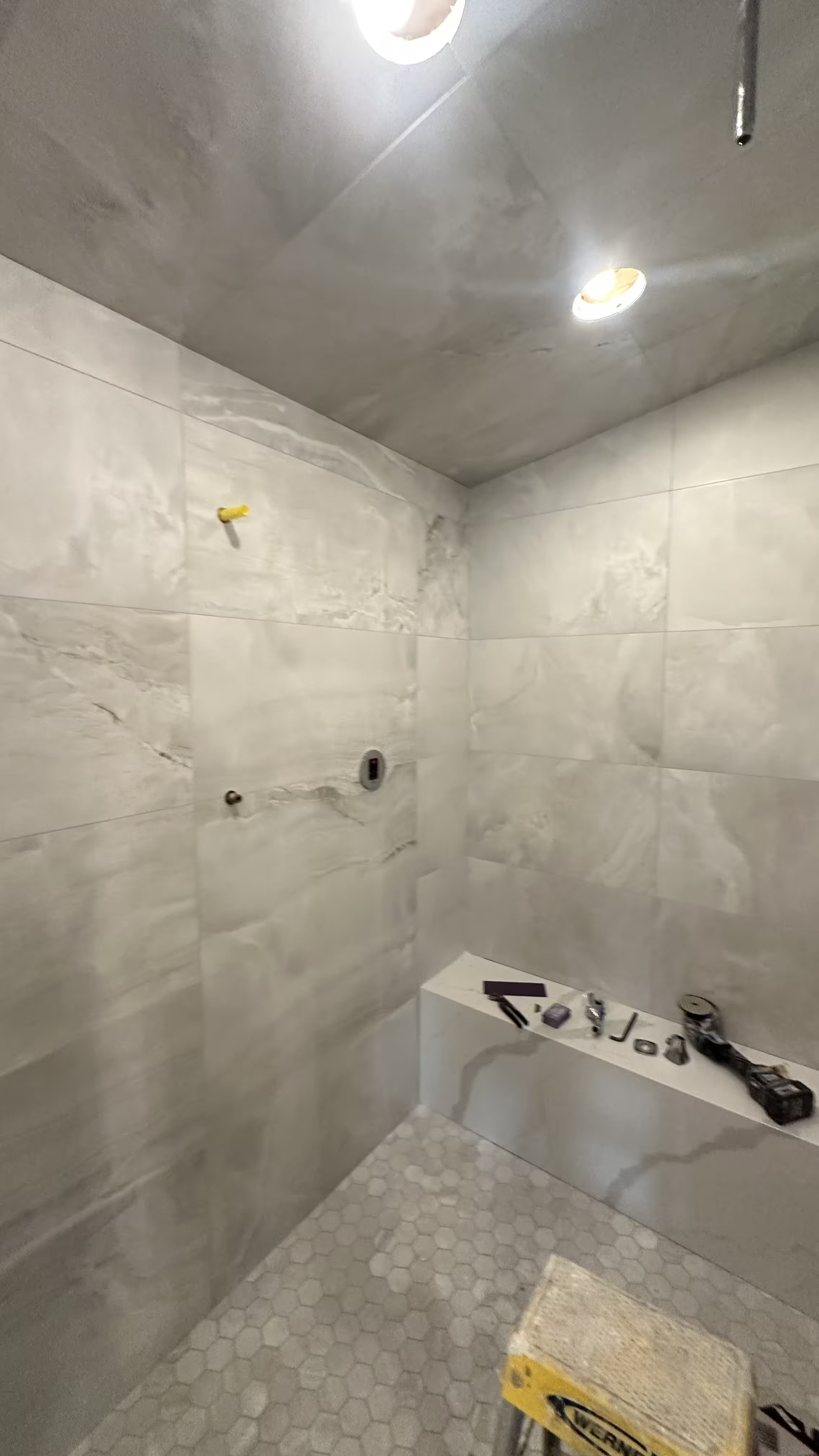
Heated floors are gentler on grout than steam, but they add thermal cycling, one of the reasons the NTCA article gives for movement joints at all. Our practice before grouting over an electric mat is to check two numbers, the grout sheet's temperature limit (Flexcolor CQ, for example, excludes continuous surface temperatures of 140°F or more) and the heating manufacturer's maximum floor temperature, and to hold the perimeter and change-of-plane joints open for sealant. For the heating side, see our bathroom tile installation page.
What it costs, relatively, and how we specify it
We do not publish grout prices because the material is a small share of a shower and the labor is not. As tiers: cement grout is the lowest material cost and the most forgiving labor. Premixed grout costs more per pail and saves mixing time. Epoxy costs the most in material, Fine Homebuilding's rough figure is two to three times cement, and the most in labor, because the cleanup window is short, a mixed unit must be used at once, and a mistake is expensive to undo. On a small shower the difference is a line item; on a whole bathroom floor it is noticeable.
Here is how that maps to our own work. Our Premium shower tier uses large-format tile with 45-degree mitered outside corners, epoxy grout, and premium-brand materials such as LATICRETE. Our Essential tier uses standard-format porcelain or ceramic tile, cementitious grout and standard trims. In both tiers every shower gets a code-listed membrane, a sloped base and a flood test before any tile goes on, because none of the grout choices above change what keeps the water in. The grout family follows the tile: polished marble pushes us toward an unsanded A118.7 cement grout, a dense mosaic floor toward whatever we can clean thoroughly in the time the sheet allows, and a steam shower away from premixed products entirely. Site conditions, tile compatibility and your jurisdiction's adopted codes can all change the right answer, so the spec is settled when we have seen the tile and the room, not before.
Choosing tile for a shower, floor or backsplash? We will tell you which grout family fits the tile, what its data sheet requires, and what that means for your schedule, before the quote is final.
Frequently asked questions
Is epoxy grout waterproof?
No grout is. Epoxy absorbs far less water than cement grout, which is why it resists stains and needs no sealer, but LATICRETE's own data sheet states that epoxy grout "is not a replacement for a waterproofing membrane." The shower is watertight because of the membrane behind the tile, not the joints in front of it.
Can I regrout my shower with epoxy over the old cement grout?
Not over it. Epoxy needs a clean joint with most of the depth available; MAPEI's sheet calls for two-thirds of the tile depth to be open. Old grout has to come out first, and the corners that were grouted need to be cleaned out and sealed with an ASTM C920 sealant instead. If the reason for regrouting is a leak, read why new grout won't fix a leaking shower before spending the money.
Which grout is best for a white marble shower?
An unsanded cement grout that meets A118.7, such as PERMACOLOR Select NS, is the conservative choice. Both epoxy sheets warn that the resin can discolor white or porous stone, and MAPEI excludes white and translucent marble outright. Sanded grout of any family can scratch a polished face. Test a patch regardless.
How long after grouting can I shower?
It depends on the product, not the family. From the sheets we read: 3 days for Prism and Flexcolor CQ, 7 days for Fusion Pro, and for the two epoxies we wait out the 7-day stain-protection window. Steam showers wait 10 to 14 days. Cold rooms and humid weather add time. Ask which product was used and read its sheet.
Sources and notes
- LATICRETE, SPECTRALOCK PRO Premium Grout data sheet DS-681.0 (rev. 0217) — meets ANSI A118.3; sanded; 1/16 to 1/2 in. joints; never needs sealing; 80 min working time at 70°F, 30 min at 95°F; light traffic 12 h, stain protection 7 days, full cure 14 days; 10 days before steam room or submerged use; not a replacement for a waterproofing membrane.
- MAPEI, Kerapoxy CQ technical data sheet (edition April 29, 2026; copy hosted by BuildSite) — meets or exceeds ANSI A118.3; 1/16 to 3/8 in. joints; no sealer required; pot life 45 to 60 min; clean after every unit, final wash within 15 to 20 min; extremely difficult to remove once cured; no walking 24 h, heavy traffic 48 h; 10 to 14 days before immersion; not for white or translucent marble; resists 212°F once cured.
- Custom Building Products, Fusion Pro Single Component Grout TDS-242 (published 3/12/2024) — ready to use, no sealing; 1/16 to 1/2 in.; 'meets many of the performance characteristics of ANSI A118.7 and A118.3'; spread only 1 to 4 minutes before cleaning; 24 h light traffic; 7 days at 70°F and 50% RH before intermittent water such as a shower; not for steam rooms, submerged use, movement joints or changes of plane.
- MAPEI, Flexcolor CQ technical data sheet (edition June 5, 2024; copy hosted by Lowe's) — meets or exceeds ANSI A118.19; 1/16 to 1/2 in.; no sealer; cleaning begins within 5 to 10 minutes; 24 h light traffic; 3 days before intermittent water; not recommended for steam rooms or saunas; not for submerged areas or areas hotter than 125°F; not for continuous surface temperatures of 140°F or more.
- Custom Building Products, Prism Ultimate Performance Grout TDS-128 (published April 13, 2026) — ANSI A118.7 calcium aluminate cement grout; consistent color, will not effloresce; walkable in 4 h; intermittent water after 3 days; submerged after 14 days; sealer optional (cure 48 h first); not for movement joints or changes of plane.
- Custom Building Products, Polyblend Plus Sanded Grout TDS-360 (published 3/22/2023) — Portland cement sanded grout exceeding ANSI A118.6 and A118.7; 1/8 to 1/2 in. joints; unsanded version for joints up to 1/8 in.; A118.7 limits: shrinkage under 0.20%, water absorption under 5%, compressive strength over 3,000 psi; haze removal after 3 h; foot traffic after 16 h; submerged after 14 days; silica aggregate can scratch some tile; movement joints required at changes of plane per TCNA EJ171.
- LATICRETE, PERMACOLOR Select NS Grout Base data sheet DS-116 (rev. 1026) — unsanded Portland cement grout meeting ANSI A118.7 for polished marble and soft glass, joints up to 1/2 in.; first cleaning at 35 to 40 min, haze at 3 h; wait 72 h before sealing; 14 days before steam room or submerged use; grouts are not replacements for waterproofing membranes.
- Sika Corporation, 'Choosing the Right Grout' technical guide (03/2025) — manufacturer white paper: A118.6 standard cement grout (sanded 1/8 to 1/2 in., unsanded 1/8 in. or less and for glass or polished stone), sealing recommended with reapplication every 2 to 3 years, discoloration from uneven hydration; A118.7 higher strength, reduced porosity, color consistency, less efflorescence; A118.19 ready-to-use; A118.3 epoxy; ASTM C920 sealant classes for movement joints.
- Howard Jancy (Custom Building Products), 'From mix to fix: The benefits of single-component grout', The Construction Specifier, June 5, 2025 — manufacturer-affiliated trade article: binder definitions for A118.3, A118.6, A118.7 and A118.19; premixed grouts use a polymer binder with no Portland cement, will not effloresce, never need sealer; not for continuously submerged installations, steam rooms or steam showers above 160°F; not for movement joints or changes in plane.
- NTCA Technical Team, 'Flexible caulk versus a non-flexible grout', TileLetter, March 1, 2021 — movement joints are needed at changes of plane and inside corners; TCNA Handbook Method EJ171; the best material is a flexible sealant meeting ASTM C920; a hard grouted joint cracks when adjoining surfaces move.
- Custom Building Products, Commercial 100% Silicone Caulk product page — conforms to ASTM C920 Type S, Grade NS, Class 25; meets TCNA EJ171; for coves, corners, changes in plane and expansion joints; usable in wet applications.
- Tile Council of North America, FAQ: Steam Rooms — 'While glazed tile is vapor impermeable, the grout is not. In fact, cementitious grout easily transmits water and vapor'; steam room methods SR613 and SR614; waterproof membrane meeting ANSI A118.10.
- Tom Meehan, 'Epoxy vs. Cement Grout', Fine Homebuilding issue 188 — cement-grouted joints require sealer, epoxy-grouted joints do not; epoxy has a shorter working time, especially when warm; hardened epoxy is hard to remove; cement residue can be buffed off the next day; epoxy may darken or yellow in sunlight.
- Robin Nicholas and Michael Schweit, 'Choosing Grout', Fine Homebuilding Project Guide: Tiling — unsanded grout for joints under 1/8 in., sanded for wider joints; sanded grout scratches soft tile, unsanded for polished marble; epoxy costs about two to three times cement grout; a mixed epoxy unit must be used at once.
Code references are to the model International Residential Code (IRC). Denver, Aurora, Parker and other metro jurisdictions adopt different editions with local amendments, so confirm requirements with your building division before relying on them. Last reviewed October 26, 2026.