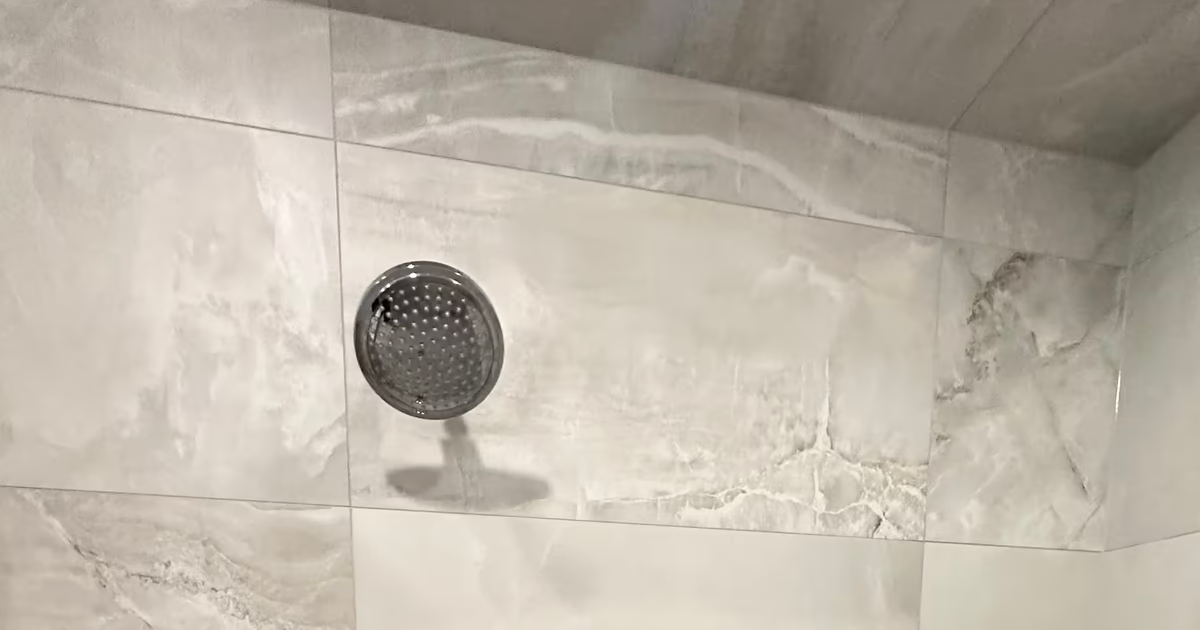
Shower wall tile gets picked in a showroom by color and price. What decides how it performs for the next twenty years is invisible on the sample board: how much water the body absorbs, what the edges look like when cut, and what the material does when it is wet every day. Here is how we sort porcelain, ceramic and natural stone for a shower, and what we recommend in each situation.
Start with water absorption, not the showroom label
Porcelain is not a different material from ceramic; it is a ceramic tile defined by a test. The industry specification, ANSI A137.1, sorts every tile into four classes by how much water it takes up under the ASTM C373 laboratory method, and a TCNA test report spells the classes out:
| Class | Water absorption (ASTM C373) | What it usually is |
|---|---|---|
| Impervious | 0.5% or less | Porcelain tile (must be impervious under A137.1); glass tile; gauged porcelain panels |
| Vitreous | More than 0.5% up to 3.0% | Dense pressed floor tile, some quarry tile |
| Semi-vitreous | More than 3.0% up to 7.0% | Pressed floor and wall tile |
| Non-vitreous | More than 7.0% up to 20.0% | Glazed wall tile (classified non-vitreous under A137.1) |
So a box marked porcelain is claiming the body absorbs half a percent of its weight in water or less. TCNA and the Ceramic Tile Distributors Association run the Porcelain Tile Certification program because tile has been sold as porcelain that was not, with "marketplace confusion, installation problems, and even liability concerns" as the result. Ask the supplier for the ASTM C373 report or look for the certification mark.
The part people get wrong: a low absorption number does not make a shower wall dry. Water goes through grout joints and around every edge, and glazed ceramic wall tile absorbs it through its unglazed back and cut edges. Every material here sits over a waterproofing membrane for the same reason; see Tile and Grout Are Not Waterproofing. Our practice on every shower is a code-listed membrane, a sloped base and a flood test before any tile goes on, whichever material the homeowner picks.
Porcelain: glazed, color-body, through-body and rectified
Porcelain earns its reputation on shower walls: the dense body shrugs off water, needs no sealing, tolerates ordinary bathroom cleaners, and takes printed marble, concrete and wood looks convincingly. Three construction types matter for a shower, as the distributor Arizona Tile describes them:
- Glazed porcelain. The color and pattern live only in the glaze on the face. The body underneath is usually a plain light or tan color, so a chip or a cut edge shows a different color than the face.
- Color-body porcelain. The body is tinted to the glaze's dominant pigment. A chip still breaks the printed pattern, but the exposed porcelain is a similar color and far less visible.
- Through-body porcelain. No glaze; the color and pattern run through the full thickness, so the cut edge matches the face.
Why does this matter on a wall nobody walks on? Outside corners, niches and curbs. Those edges are either covered with a bullnose or metal profile, or the tile is mitered at 45 degrees so two faces meet at a sharp line with no trim. A miter on glazed porcelain exposes a sliver of body color; on color-body or through-body tile that line all but disappears. On our Denver steam shower we mitered the outside corners and the niche rather than capping them with metal, then wet-polished each edge. That is extra fabrication time, and it is why our Premium tier pairs large-format porcelain with mitered corners.
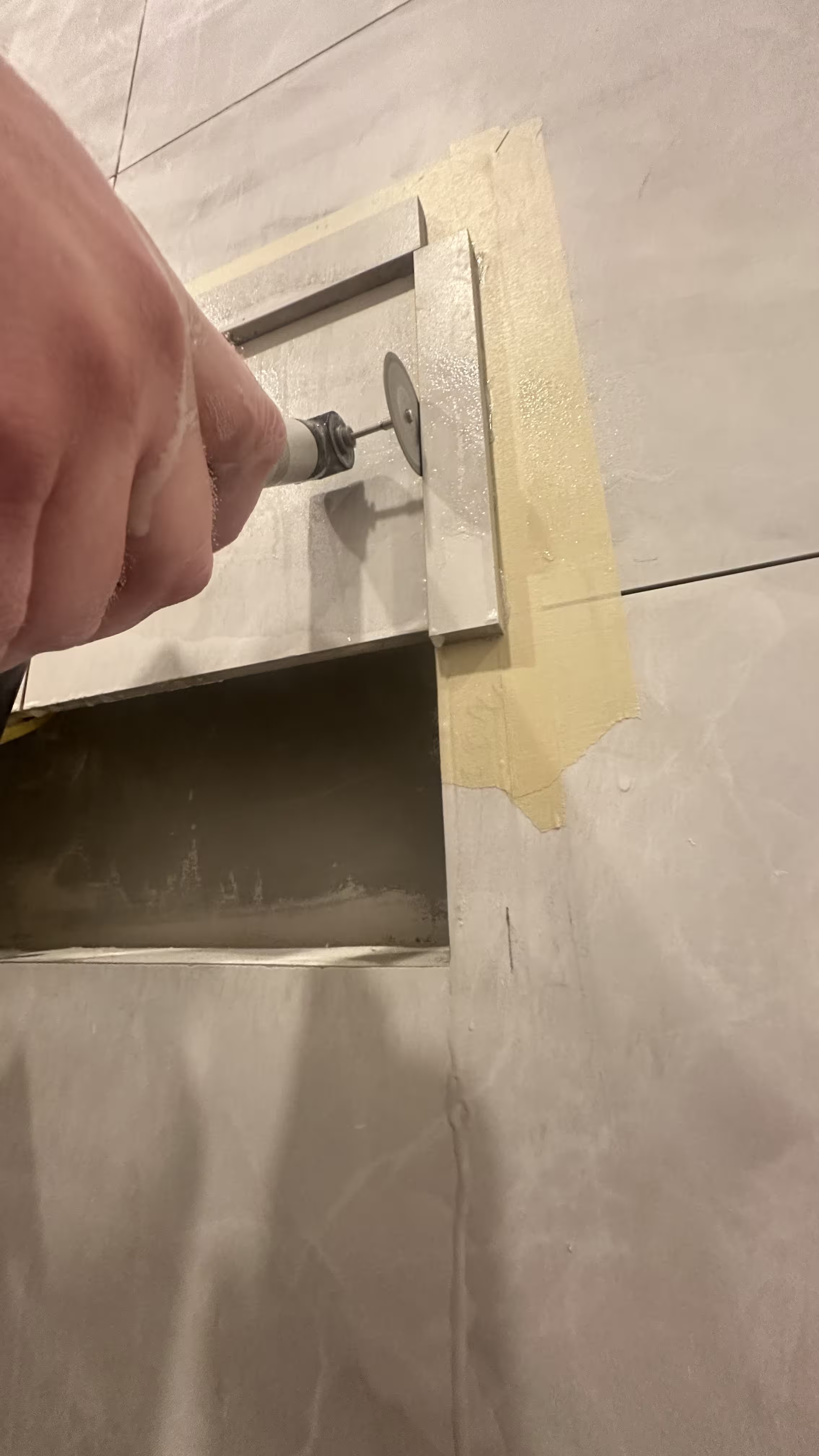
The other word on the box is rectified: the edges were ground square after firing, so every piece is the same size within a tight tolerance, which is what allows narrow joints. The installation standard sets the rule. Under ANSI A108.02 section 4.3.8, as TileLetter summarizes it, the joint must be at least three times the actual variation in the tile's facial dimensions and never less than 1/16 inch; in practice that is roughly 1/8 inch for rectified tile and about 3/16 inch for pressed tile. "No grout lines" is not a thing. A 1/8 inch joint in a matching epoxy grout is, and it is what people are picturing when they ask.

Two ratings on porcelain samples matter much less on a wall than on a floor. PEI is an abrasion test of the glaze, and as the tile retailer Centura notes, PEI 1 and 2 tiles are rarely used for floors and are mainly wall tiles; a low PEI is not a defect on a shower wall. Mohs scratch hardness is the same story. What does matter on a wall is flatness and format: large tile shows every ripple in raking light and needs the substrate prep in 24x48 Porcelain Tile Wall Preparation, and gauged panels are their own discipline, covered in our gauged porcelain installation guide.
Ceramic: what it does well and where it stops
Glazed ceramic wall tile is what most showers in the Denver metro were built with, and it is still a sound choice. It is the lowest material tier of the three. It is lighter, which matters on a ceiling or a tall wall. The softer body cuts cleanly on a manual snap cutter, so work around valves and niches is faster than running every piece through a wet saw. And the glazed face cleans like porcelain, because the glaze does not absorb water.
Its limits come from the body under the glaze. Glazed wall tile is in the non-vitreous class: the unglazed back and every cut edge soak up water readily. Over a proper membrane that is not a leak risk, but it has three practical consequences:
- Edges need bullnose or a metal profile. A mitered corner on glazed ceramic shows a band of raw bisque and chips. If you want miters, you want porcelain.
- Cut edges in a niche or at a curb should not be the exposed face, because the body wicks whatever water reaches it.
- Ceramic sold for walls is not rated for the shower floor, so most of our ceramic showers get a porcelain mosaic on the floor.

Our Arvada fluted shower shows the trade-off. The glazed fluted tile needs nothing exotic in upkeep, but the ribbed profile cannot be bullnosed, so every exposed edge had to be mitered or finished with a slim metal profile, and the layout had to land a full flute at each corner. A textured tile is a design choice first and a materials choice second.
Natural stone: beautiful, and a maintenance commitment
Marble, limestone, travertine and slate are real, and nothing printed on porcelain is quite the same up close. They are also the only shower wall material that changes chemically in service. This is not an argument against stone; it is the list we go through with every homeowner who asks for it.
Etching from cleaners
Marble, limestone and travertine are calcareous, mostly calcium carbonate, which acids dissolve. The Natural Stone Institute puts it plainly: products containing lemon, vinegar or other acids may dull or etch calcareous stone. That includes most bathroom and hard-water cleaners on a grocery shelf. An etch is not a stain; it is a dull spot where the polish has been eaten away, sealer does not prevent it, and repair means refinishing by a stone professional. Slate is not calcareous and shrugs off acids.
Sealing, and what it does not do
The sealers used on stone are impregnators. In the Institute's words they "act as a repellent rather than a sealer," and sealing "does not make the stone stain proof, rather it makes the stone more stain resistant." Sealer slows water and soap from soaking in; it does not waterproof the wall, and it wears off. MAPEI's bulletin goes further for sensitive stone: seal it on all sides before installation, seal the whole area again after grouting, and follow the reapplication schedule. Resealing is a recurring cost, not a one-time step.
Iron staining and "bleeding" in white marble
Some white marbles, Carrara among them, carry iron minerals that oxidize with enough water exposure. A renovation contractor quoted by Brick Underground describes it directly: white and Carrara marble "sometimes contains deposits of iron which, if exposed to water, can cause rust stains," and the experts there call it not uncommon in showers. The stain comes from within the tile, so no cleaner on the face prevents it; a poultice can lift some, and a badly affected tile gets replaced. If you are set on white marble, buy extra tile, run the exhaust fan, and squeegee.
Moisture-sensitive stone and warping
Certain stones react with the water in the mortar itself. MAPEI's bulletin on moisture-sensitive stone explains that these stones can cup, curl, dome and warp, pull away from the mortar, and "generally ... cannot be repaired or reinstalled." Its list includes the green marbles (Alpine Green, Guatemala Green, Jade Green and others), Bianco Carrara, Negro Marquina, Portoro, Rosso Levanto, and limestone as a category. The manufacturer instruction is to set them only with water-free, reaction-resin materials, and MAPEI restricts even those installations to dry and limited-water-exposure areas. LATICRETE says the same: for green marble and other water-sensitive stone, use a 100% solids epoxy adhesive, and consult the stone supplier. A current distributor guide for serpentine green marble allows shower walls only with waterproofing and epoxy setting materials, and rules out steam rooms entirely.
Day-to-day upkeep
The Natural Stone Institute's shower advice is short: a squeegee after each use, a neutral cleaner or stone soap rather than a general-purpose spray, and a non-acidic soap scum remover when needed; over-using ammonia can eventually dull some stone. Porcelain asks for none of it. That is the honest trade: a daily habit and a resealing schedule for a surface nothing else quite matches.
Mosaics, glass and pebbles as accents
Accent materials are easier decisions, because they do a job. On the shower floor, a mosaic lets the tile follow the slope to the drain and adds grip through its joints; our Highlands Ranch master bath used a penny-round mosaic on the floor and inside the niche against large-format marble-look porcelain walls. Glass tile is impervious under its own specification, ANSI A137.2, and works as a niche back or a band, with two cautions: edges need a profile or a careful miter, and white mortar matters even more behind translucent glass than behind light stone.
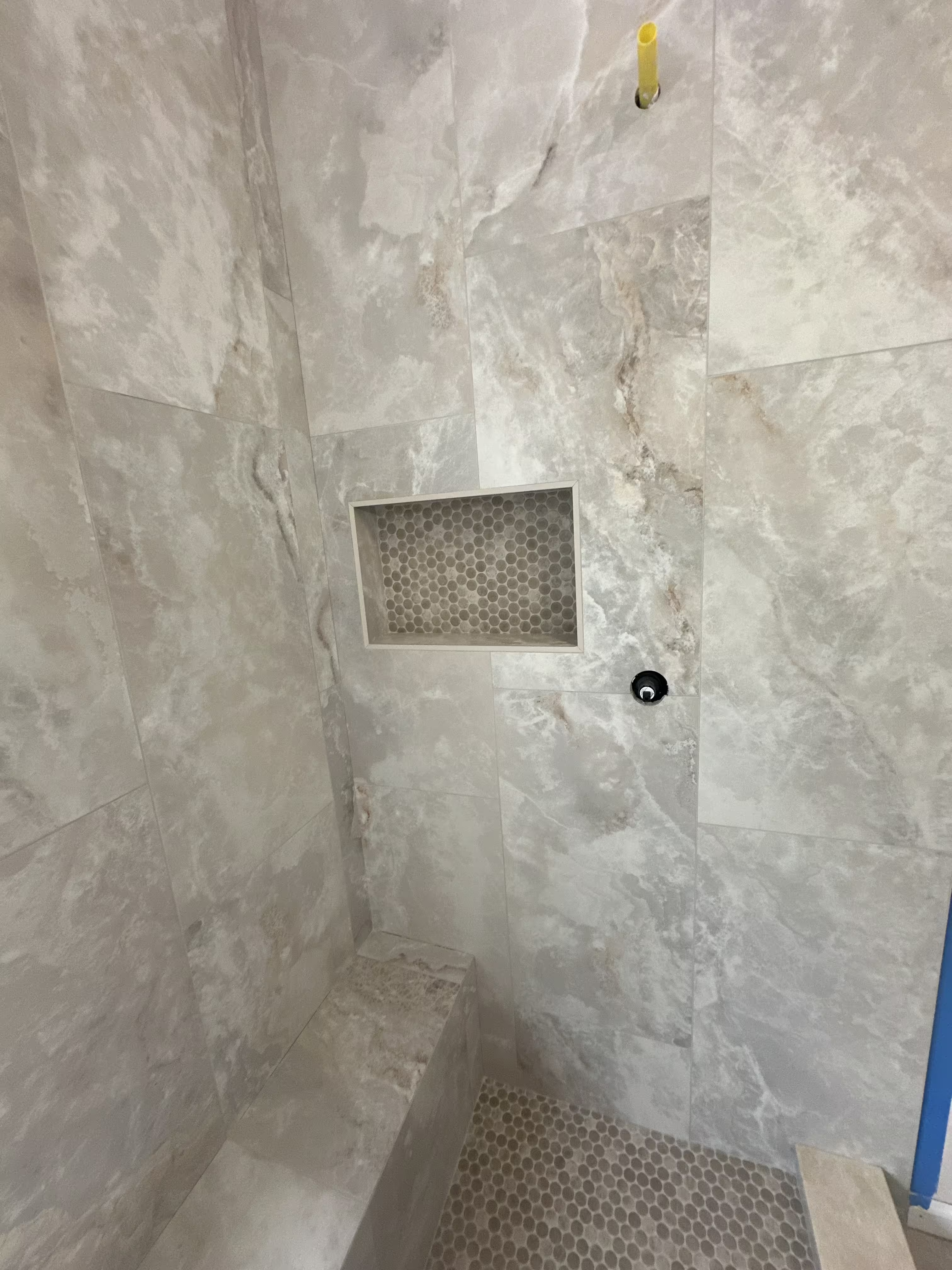
Mixing materials is fine, as long as all of them sit on one continuous membrane and the setting materials suit the most demanding piece. A marble mosaic accent in a porcelain shower brings the whole marble care list with it, on a smaller surface.
Cleaning, hard water and the Denver angle
Denver's water helps. According to Denver Water, the city's supply is "soft to moderately hard": the southern collection system runs about 75 to 120 mg/L of hardness, the northern system typically 40 to 50 mg/L, and it is a bit harder in winter. That is gentler on glass and tile than much of the country, but spots and a chalky film on dark tile still show up, and suburbs on other districts can differ, so check your own provider's report.
The material question is what removes that film. On glazed porcelain and ceramic, the usual descaling products are fine for the tile; check the grout manufacturer's guidance, since cementitious and epoxy grouts react differently (see Epoxy vs. Cementitious vs. Premixed Grout). On marble or limestone, the same descaler is an etching agent; the Natural Stone Institute suggests buffing hard-water buildup on stone with dry 0000 steel wool rather than dissolving it. If you will not keep up with a squeegee, that alone should push you toward porcelain.
Cost tiers and what we recommend by situation
We do not publish material prices because the spread within each category is wider than the spread between them. What we can say is how the tiers stack up, counting the tile, the labor and the setting materials it requires:
| Material | Relative material tier | Labor and setting materials | Ongoing care |
|---|---|---|---|
| Glazed ceramic wall tile | Lowest | Fastest to cut; needs bullnose or profiles at edges; cementitious grout is typical | Clean the glaze; regrout joints over time |
| Standard-format glazed porcelain | Low to mid | Wet saw for every cut; profiles or careful miters | Minimal; no sealing |
| Large-format or through-body porcelain, mitered | Mid to high | Flat substrate prep, back-buttering, leveling clips, miter fabrication and polishing; epoxy grout in our Premium tier | Minimal; fewer joints to maintain |
| Natural stone (marble, limestone, travertine, slate) | Highest | White or epoxy mortar depending on the stone, sealing on all sides, more waste from veining and breakage | Neutral cleaners only, squeegee, periodic resealing, possible refinishing |
Those tiers are a general observation, not a quote; an exotic porcelain can cost more than a common marble. Here is how the choice usually resolves:
- Steam shower. Porcelain, no exceptions on our jobs. Constant humidity is the condition that etches, stains and warps sensitive stone, and the serpentine guide above rules out steam rooms outright. Our Denver steam shower used large-format marble-look porcelain on the walls, sloped ceiling and bench; see our steam shower page.
- You want the marble look and a normal life. Marble-look porcelain. The Highlands Ranch master bath and the Denver steam shower are both marble-look porcelain; the veining reads as stone from across the room without the sealing, etching or iron-staining concerns.
- Family bathroom, kids, hard use. Glazed porcelain in a standard format with profiles, or large-format porcelain if the walls are flat and the budget allows. Both tolerate whatever cleaner ends up under the sink.
- Hall bath on a budget, or a rental. Glazed ceramic in a classic format with bullnose trim, cementitious grout and a porcelain mosaic floor. That is the general shape of our Essential tier: standard-format porcelain or ceramic, cementitious grout, standard trims, over the same membrane, slope and flood test as every shower we build.
- Fewer joints, easier access, aging in place. Large-format porcelain. On the Highlands Ranch corrective rebuild we paired 24x48 marble-look porcelain with a floating bench, grab bars and a hexagon mosaic floor.
- You want real stone and you will care for it. Then do it properly: a dense marble or slate rather than a soft limestone, the supplier's written installation guidance, white or epoxy mortar as that guidance requires, sealing before and after grouting, extra tile set aside, and a squeegee on a hook. Stone is a fine choice for the right owner.
Two things are not a materials decision at all. The membrane, slope and flood test are the same under every one of these. And the right setting materials depend on the specific product, substrate and membrane, so a data sheet beats a rule of thumb; product compatibility, site conditions and local jurisdiction can all change the right method, and we check them on the job rather than assume.
Bring the samples you are considering and we will tell you which ones will behave in your shower, what each needs behind it, and what the upkeep really looks like. Porcelain, ceramic or stone, every shower we build gets a code-listed membrane, a sloped base and a flood test before the first tile.
Frequently asked questions
Is porcelain tile waterproof?
No. Porcelain is impervious by the test, meaning the body absorbs 0.5% water or less, but a shower wall is tile plus grout joints, edges and penetrations, and water gets past all of those. The waterproofing is the membrane behind the tile, whichever material you choose.
Can I put marble in a steam shower?
We will not, and we recommend against it. Constant vapor activates iron staining in white marble, and current distributor guidance for serpentine green marble excludes steam rooms entirely. Marble-look porcelain gives the look without the risk. If a stone's supplier states in writing that it is suitable for steam, that document should drive the decision.
Does rectified tile mean I can have no grout lines?
No. The installation standard requires the joint to be at least three times the tile's actual size variation and never less than 1/16 inch; in practice rectified tile gets about a 1/8 inch joint. What you can have is a narrow joint in a matching grout, which from a few feet away reads as one surface.
Do I need to seal porcelain or ceramic?
Glazed porcelain and glazed ceramic do not need sealing; the glaze is the surface. Some polished or unglazed porcelains carry a manufacturer recommendation for a sealer, so read the product's data sheet. Cementitious grout is a separate question and is usually sealed; epoxy grout is not. Natural stone always needs sealing, on a schedule.
Sources and notes
- Tile Council of North America, Test Report TCNA-0743-19 (ASTM C373-18 water absorption), published by MS International — classification table: impervious 0.5% or less; vitreous over 0.5% to 3.0%; semi-vitreous over 3.0% to 7.0%; non-vitreous over 7.0% to 20.0%. Under ANSI A137.1 porcelain tile shall be impervious and glazed wall tile is classified as non-vitreous; glass tile under A137.2 is impervious.
- Tile Council of North America: Porcelain Tile Certification (PTCA) — porcelain defined as impervious tile with water absorption of 0.5% or less by ASTM C373; program launched by CTDA and TCNA because of tile mislabeled as porcelain.
- Paul Makovski, TileLetter: About grout joint width (November 2019) — ANSI A108.02 section 4.3.8: joint width three times the actual variation in facial dimensions, never less than 1/16 inch; roughly 1/8 inch for rectified and 3/16 inch for pressed tile.
- Arizona Tile: Color Body Porcelain vs. Through Body Porcelain Tile (June 2020) — definitions of glazed, color-body and through-body porcelain and how each shows a chip.
- Centura: What is the PEI of a tile? (October 2020) — PEI is a surface abrasion test for glazed tile; PEI 1 and 2 are rarely used for floors and are mainly wall tile.
- MAPEI Technical Bulletin: Installing moisture-sensitive stone (August 2018) — moisture-sensitive stones (including Bianco Carrara, limestone, several green marbles and Negro Marquina) can cup, curl, dome or warp; set with water-free materials; restricted to dry or limited-water-exposure areas; seal on all sides before installation.
- LATICRETE 253 GOLD Product Data Sheet DS-296-1124 — use white mortar for white or light-colored marble/stone; use LATAPOXY 300 for green marble and water-sensitive stone; mortars and grouts are not replacements for waterproof membranes.
- LATICRETE FAQ: Which adhesive should I use for green marble or other moisture sensitive stone? — 100% solids epoxy adhesive; consult the stone supplier for installation instructions.
- TileBar: Verde Green Marble Installation and Usage Guidelines (February 2026) — serpentine green marble: shower walls only with waterproofing and epoxy setting materials; not recommended for steam rooms; acid-sensitive; periodic resealing required.
- Natural Stone Institute: Stone Care — neutral cleaners; lemon, vinegar and other acids may dull or etch calcareous stone; sealers are impregnators that make stone more stain resistant, not stain proof; squeegee after each use in wet areas.
- Brick Underground: The white marble in my bathroom is starting to turn brown (October 2017) — white and Carrara marble can contain iron deposits that rust when exposed to water; not uncommon in showers.
- Denver Water: The hard truth about soft water (July 2017) — Denver's water is soft to moderately hard; southern collection system 75 to 120 mg/L, northern system typically 40 to 50 mg/L; harder in winter.
- South Denver Tile Experts: Custom steam shower installation, Denver (project record)
- South Denver Tile Experts: Large-format tile shower remodel, Highlands Ranch (project record)
- South Denver Tile Experts: Master bathroom remodel, Highlands Ranch (project record)
- South Denver Tile Experts: Green fluted tile shower, Arvada (project record)
Code references are to the model International Residential Code (IRC). Denver, Aurora, Parker and other metro jurisdictions adopt different editions with local amendments, so confirm requirements with your building division before relying on them. Last reviewed October 26, 2026.