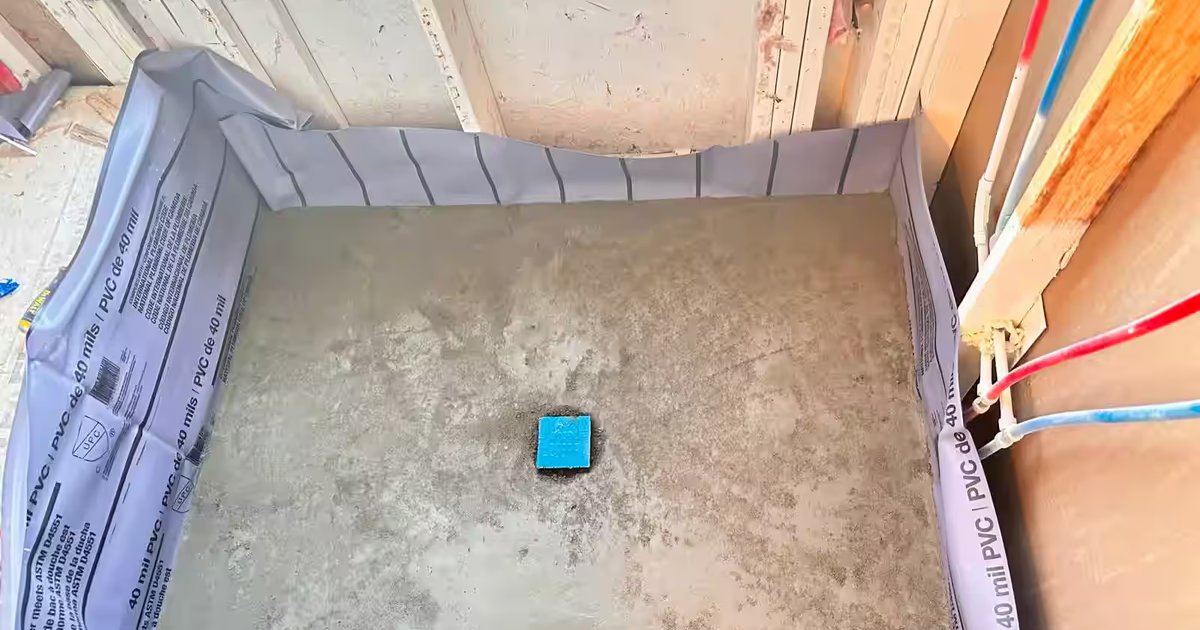
Most of what makes a shower last is invisible by the time you see it. The membrane, the slope under the liner, the height the liner climbs the wall, the sealant in the corners: all of it is under tile within days. Choosing a shower contractor is really choosing who does those hidden days properly. Here is how to tell before you sign.
Why a shower is not a regular remodel
A badly set kitchen floor shows itself: lippage, hollow tiles, crooked lines. A badly built shower can look perfect for months. Tile and grout shed most of the water but are not the waterproofing, as we explain in Tile and Grout Are Not Waterproofing. The membrane or liner, the slope beneath it, the drain connection and the sealant at every change of plane are the shower. The tile is the finish.
That hidden work gets one test. The model plumbing code (the International Residential Code, adopted by metro jurisdictions in different editions with local amendments) requires the completed liner to be flood tested: drain plugged, water at least 2 inches deep at the threshold, held at least 15 minutes, with no evidence of leakage. After tile, the only test left is time, and failures often show up first on the ceiling below. What Causes a Shower Pan to Fail covers why.
References and finished photos tell you a contractor can make a shower look good. You need to know what they do on the days nobody sees.
Eight questions that sort tile setters from shower builders
None of these are trick questions, and a contractor who builds showers for a living will answer them without hesitating. Listen less for vocabulary than for a system.
| Ask | Weak answer | Answer that shows competence |
|---|---|---|
| What waterproofing will you use, by name? | "The tile is waterproof." "We seal the grout." | A named product and system: a bonded sheet or liquid membrane meeting ANSI A118.10, or a PVC or CPE liner under a mortar bed (the code lists all of them), and how it connects to the drain. |
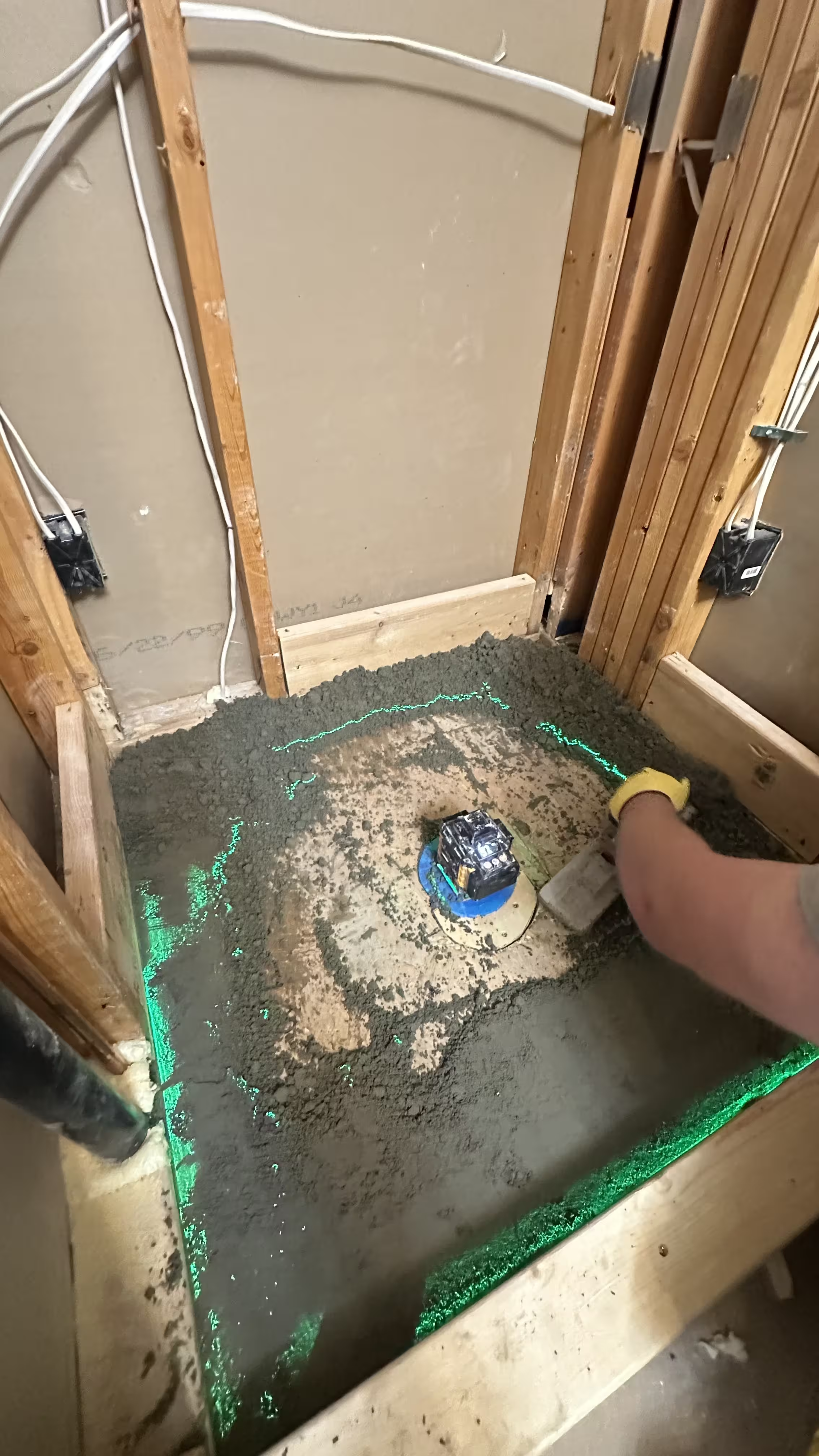
| Is there slope under the liner? | "The mortar bed on top is sloped." | Yes. The code requires the lining itself to slope 1/4 inch per foot to the weep holes. In bonded systems the slope is in the base under the membrane. |
| Do you flood test, and can I see it? | "We've never had a leak." | Yes, every shower: drain plugged, pan filled, water level checked. You can watch, or get a timed photo. |
| How high does the liner go? | "To the floor." | At least 2 inches above the threshold and around the jambs (the code minimum), never nailed through less than 1 inch above the threshold. Bonded wall membranes cover the area the manufacturer specifies. |
| What goes in the corners and where the floor meets the wall? | "Grout, same as everywhere." | Flexible sealant. NTCA's technical team calls for movement joints at changes of plane and inside corners, filled with an ASTM C920 sealant. |
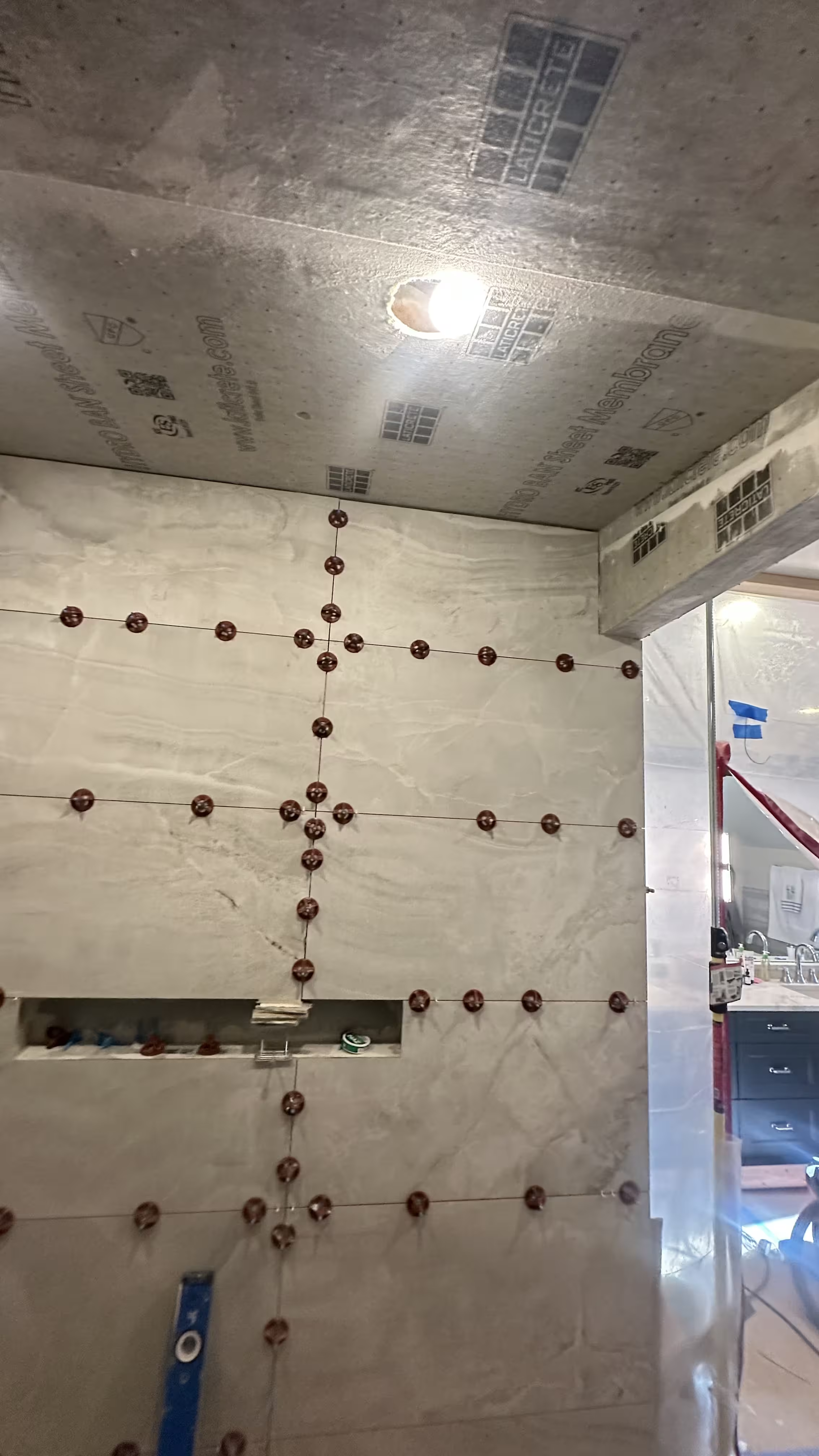
| What mortar for 24x48 tile? | "Regular thinset." | A large-and-heavy-tile mortar (ANSI A118.15 with the H designation), back-troweled, coverage checked; Custom Building Products calls for at least 95% in wet areas. More in Why 24x48 Porcelain Tile Requires Better Wall Preparation. |
| Who pulls the permit and does the plumbing? | "You don't need one." "You pull it." | They name the jurisdiction and who pulls the permit, and use a state-licensed plumber or electrician when a drain, valve or circuit moves. |
| What if you find rot when the old shower comes out? | "We'll handle it." | Work stops, the damage is photographed and shown to you, and a written, priced change order is approved before any extra work. |
Two answers are worth seeing rather than hearing: how high the liner goes, and the slope under it.

Licenses and insurance in Colorado
Homeowners often ask for a "Colorado contractor license number." For a tile or remodeling contractor there is none to give: Colorado licenses plumbers and electricians at the state level and leaves building contractor licensing to cities and counties. The Attorney General's consumer site says to "check with your city or county to make sure the general contractor is licensed to work in your area" and to search plumbing and electrical licenses through the Department of Regulatory Agencies (DORA). Local licenses do not travel, either: Denver does not accept or reciprocate contractor licenses from other counties or states.
| Where | What exists | How to check |
|---|---|---|
| Denver | Community Planning and Development licenses contractors. A supervisor certificate (or an employee who holds one) comes first; a Colorado plumbing or electrical license substitutes for it. | CPD's "Verify a contractor's license" tool; (720) 865-2770 |
| Aurora | Contractor and supervisor licenses. Plumbers and electricians file their state master's and contractor's licenses with the Building Division; the city issues no separate plumbing or electrical license. | The city's Contractor Lookup; 303-739-7420 |
| Parker | "All contractors are required to be licensed in the Town of Parker." The Building Division sets up each registration. | Call the Building Division, 303-841-1970 (registration page) |
| Plumbing and electrical, statewide | State licenses through DORA. | Ask for the license holder's name and number and search DORA's lookup. |
Other metro cities and counties set their own rules, so ask what your address requires and whose name the permit will be under. Our guide to bathroom remodel permits in Aurora, Parker and Denver covers the permit side.
Insurance: what to ask for
The FTC's Hiring a Contractor guide lists personal liability, worker's compensation and property damage coverage, and says to "ask for copies of insurance certificates, and make sure they're current, or you could be held liable for any injuries and damages that occur during the project." The NAHB's hiring checklist names workers' compensation and general liability.
A certificate of insurance is a one-page summary issued by the insurer: the insurance company, the contractor's legal business name, coverage types, policy numbers, effective dates and limits. Check that the dates cover your project and the name matches your contract. Our suggestion: have the agent send it to you directly, with you listed as certificate holder. Parker's registration page links a "Statement of Exemption from Workers Compensation Law," so not every registered contractor carries that coverage; if yours does not, ask who pays if a helper is hurt in your home.
Industry credentials: a plus, not a requirement
Beyond local and state trade licenses, no credential is required to build a shower in Colorado, and many good shower builders hold none of these. Treat them as evidence, not a filter.
- Certified Tile Installer (CTI). Run by the Ceramic Tile Education Foundation. Candidates need two years as a full-time lead installer, then pass a 155-question open-book exam and a hands-on test covering layout, membranes, backer board, tile, grout and sealant. CTEF publishes a directory, so the claim is checkable. It certifies a person: ask whether that person will set your tile.
- Advanced Certifications for Tile Installers (ACT). Also CTEF, for pre-qualified installers in seven areas; three matter here: Membranes, Shower Receptors, and Large Format Tile & Substrate Preparation.
- NTCA membership. A 2025 TileLetter article describes the National Tile Contractors Association as "the world's largest tile trade organization," with a mission of installation training and education. Membership is an affiliation, not a test of the installer; ask what training the person setting your tile has taken.
- TCNA Handbook. The Tile Council of North America calls its Handbook "a guide to assist in clarifying and standardizing installation specifications for tile," including wet-area guidelines and workmanship standards excerpted from ANSI. A contractor who can name the method your shower follows is building to a documented system.
Know which kind of rule you are hearing. The flood test and liner height are building code; ANSI A118.10 membranes and ASTM C920 sealants are industry standards; the 95% coverage figure is a manufacturer instruction; "we flood test every shower" is company practice. A good contractor knows the difference.
Portfolio, references and reviews
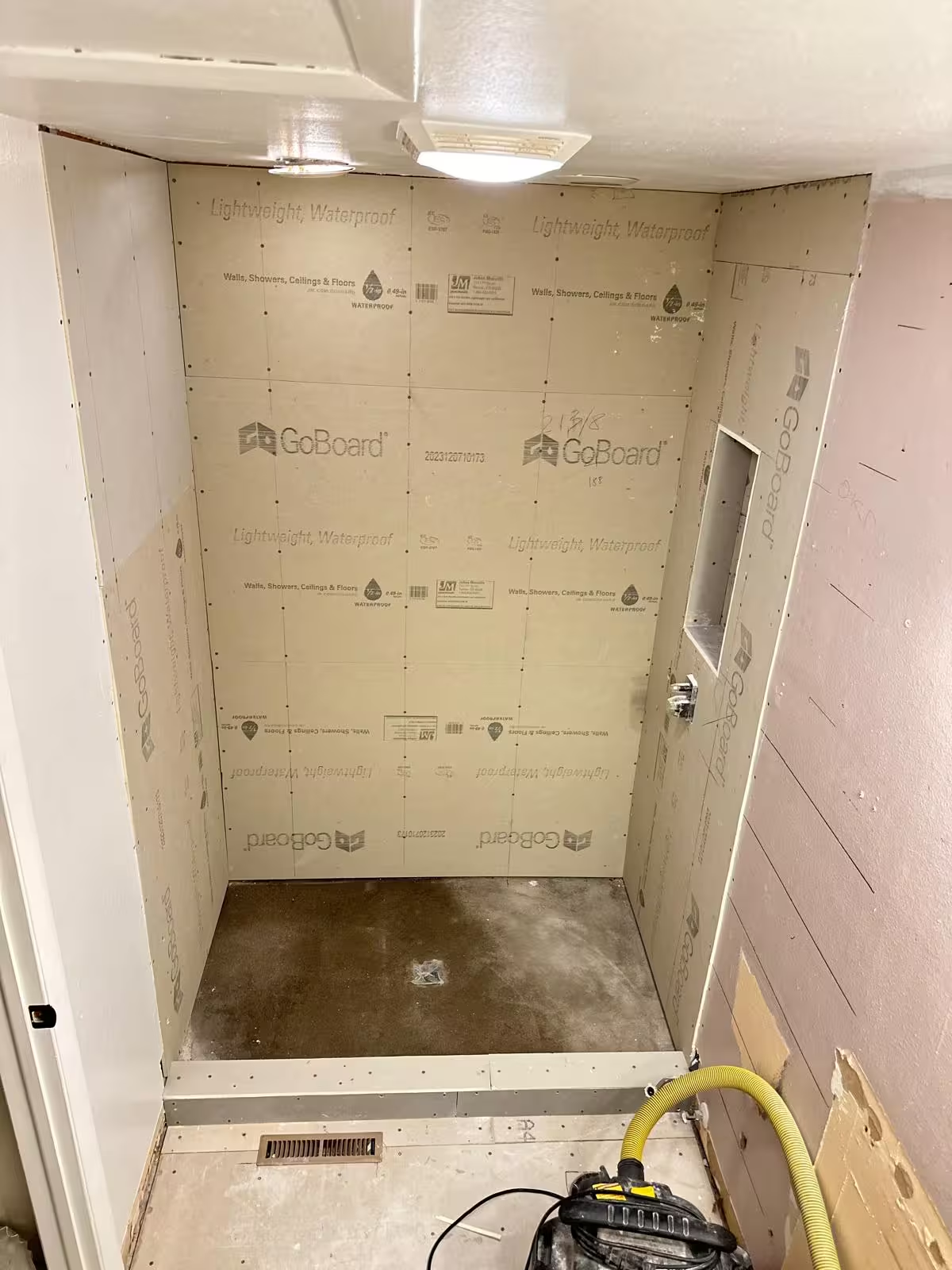
Finished photos prove someone can set tile. The photos that prove they can build a shower are the ones nobody frames: membrane before tile, the liner behind the bottom rows, the pre-slope, a pan holding water. The NAHB says to ask to see work "both completed and in progress," and the FTC suggests visiting jobs in progress.
The FTC says a contractor should be able to give you at least three clients with projects like yours, and suggests asking how long ago the work was done, whether it finished on time and whether there were unexpected costs. For a shower, call one from a year or more back and ask about stains on the ceiling below.
On a Google Business Profile, read past the star average. Look for specifics, such as waterproofing, a flood test, or a problem that was found and how it was priced, and read the low reviews and the owner's replies: that is how criticism of your job would be handled. The FTC suggests searching the company name with words like "complaint" and "review" and reading reviews critically.
Reading the quote and the contract
A one-line "shower remodel, $X" quote cannot be compared with anything. The FTC suggests written estimates from several contractors, not automatically the lowest, and asking why they differ. A readable shower quote itemizes:
- Demolition and disposal.
- The waterproofing system by name, the pan type, and the flood test as a step.
- Framing or subfloor repair as an allowance, with the rate if it is exceeded.
- Plumbing and electrical: who does it, and whether permit fees are included.
- Tile material separately from labor; if it is an allowance, the budget for each item.
- Grout, sealant, trims, edge treatment, niche and bench.
- Exclusions in writing, such as paint, flooring outside the shower, or the ceiling below.
The cost drivers in Bathroom Remodeling Costs in Denver: What Affects the Price? and the tiers in Essential vs. Premium Shower Remodeling Options are easier to compare when every quote is itemized this way.
The contract
The FTC's guide says a contract should include the contractor's name, address, phone and license number (if required); estimated start and completion dates; the payment schedule; the contractor's obligation to get all necessary permits; how change orders are handled; a detailed materials list, with any allowances; warranty information; what the contractor will and won't do; promises made in conversation; and, if you signed at home or anywhere other than the seller's permanent place of business, your right to cancel within three business days. For a shower, also name the waterproofing system and the flood test.
On payment, the FTC says don't pay cash, limit the down payment, tie payments to completed work, and never make the final payment until the work is done and you're satisfied. Colorado's Attorney General lists "asking for more than 10% of costs up front" among contractor warning signs.
Before the final payment, the FTC also says to confirm that subcontractors and suppliers have been paid, because state law may let them file a mechanic's lien against your home, and to ask the contractor and every subcontractor and supplier for a lien waiver. Colorado's lien statute gives the owner of an existing single-family home an affirmative defense once the full contract amount plus change orders has been paid to the principal contractor. We are not lawyers: collect the waivers, and call an attorney if a lien appears.
What a "lifetime warranty" covers
Read the document, not the ad. The FTC says the contract should name who honors each warranty (contractor, distributor or manufacturer), its length and its limitations; that anything not listed should be assumed not covered; and that spoken promises belong in writing. Ask: lifetime of what? Labor or only materials? Water damage below? What voids it? Is it transferable? No warranty substitutes for a flood test.
Red flags
- "Tile is waterproof," or grout sealer described as the waterproofing.
- No flood test. The code requires one for lined receptors; skipping it asks you to take their word for the one thing that can be checked.
- No named membrane. "Waterproofing" is a category, not a product.
- No permit for a drain or valve move, or asking you to pull it. The FTC lists the second as a warning sign; the Attorney General lists "refusing to pull required local permits."
- Cash only, gift cards, cryptocurrency, or a large deposit. The FTC and the Attorney General both flag cash demands and large up-front payments.
- Door-to-door selling or pressure to sign today.
- No certificate of insurance, or one in a different business name.
- "We'll handle anything we find," with no written change-order process.
- Only finished photos.
For what "anything we find" can mean, see What We Found After Shower Demolition. The right response to a surprise is a photo, a conversation and a priced change order, in that order.
Printable checklist
Before you sign, every line should be a yes.
- The waterproofing system and pan type are named in writing.
- There is slope under the liner or membrane.
- Every shower is flood tested, and you can watch or get photos.
- The liner rises at least 2 inches above the threshold.
- Changes of plane get ASTM C920 sealant, not grout.
- Large tile gets an ANSI A118.15 mortar with coverage checked.
- The permit, the jurisdiction and who pulls it are named.
- You verified the local license and any state plumbing or electrical license.
- You hold a current certificate of insurance in the contracting business's name.
- You have seen in-progress photos and called a reference from a year or more ago.
- The quote is itemized, with allowances and exclusions in writing.
- The contract names dates, milestones, the change-order rule and warranty terms.
- The deposit is modest, and you will collect lien waivers with each payment.
Deciding whether to repair or replace first? Start with Shower Repair vs. Complete Rebuild.
Our own practice, so you can hold us to it: every shower gets a code-listed membrane, a sloped base and a flood test before tile, and when we find something behind the old walls we photograph it and show you before the scope changes. Ask us the eight questions above; we would rather answer them than have you guess.
Frequently asked questions
Does a shower contractor need a license in Colorado?
Not from the state for tile and general construction. Plumbing and electrical work requires state licenses issued through DORA. Building contractor licensing is local: Denver issues its own and does not reciprocate, Aurora licenses contractors and supervisors, and Parker requires every contractor to be licensed with the Town. Check the rule for your address.
Should I hire a tile setter or a general contractor?
Either can work. What matters is that one person owns the waterproofing from the drain to the top of the wall, and that plumbing is done by a state-licensed plumber. Split jobs fail at the gaps: a drain the tile setter did not plan for, or backer board everyone assumed someone else waterproofed. Ask who owns the membrane and the flood test. The answer should be a name.
How big a deposit is normal?
Colorado's Attorney General treats more than 10% up front as a warning sign, and the FTC says to limit the down payment and tie payments to completed work. Sensible shower milestones: demolition done; waterproofing done and flood tested; tile done; glass installed. The final payment follows your walkthrough.
The contractor says a bonded membrane doesn't need a flood test. True?
Ask them to test anyway. The code's liner test applies to receptors made watertight with the materials it lists, and bonded membranes meeting ANSI A118.10 are on that list. A bonded membrane still has seams, corners and a drain connection, and a test needs only a plug, water and time. We flood test every shower we build, whatever the system.
Sources and notes
- 2021 International Residential Code, Section P2503.6 Shower Liner Test (UpCodes) — drain plugged; water at least 2 inches deep at the threshold, retained at least 15 minutes with no evidence of leakage.
- 2021 International Residential Code, Section P2709 Shower Receptors (UpCodes) — lining materials include PVC (ASTM D4551), CPE (ASTM D4068) and bonded sheet or liquid membranes meeting ANSI A118.10; lining at least 2 inches above finished thresholds and around the rough jambs; sloped 1/4 in 12 to the weep holes; not nailed or perforated less than 1 inch above the finished threshold.
- City and County of Denver, Community Planning and Development: Contractor Licensing — supervisor certificate (or an employee who holds one) required before a contractor's license; a Colorado electrical or plumbing license substitutes; no reciprocity with other counties or states; license verification tool; (720) 865-2770.
- City of Aurora: Contractor Licensing and Lookup — Contractor and Supervisor licenses; Contractor Lookup tool; plumbers and electricians need a current State of Colorado master's and contractor's license on file; no separate city plumbing or electrical license; 303-739-7420.
- Town of Parker: Obtaining Permits — "All contractors are required to be licensed in the Town of Parker"; Building Division 303-841-1970.
- Town of Parker: Contractor Registration — registration set up by the Building Division through eTrakit; links a Statement of Exemption from Workers Compensation Law.
- Colorado Attorney General, Consumer Protection Section (Stop Fraud Colorado): Contractor Fraud — check with your city or county that the general contractor is licensed; plumbing and electrical licenses searchable through DORA; warning signs include more than 10% of costs up front, cash, gift card or cryptocurrency payment, refusing to pull permits, door-to-door solicitation.
- Federal Trade Commission: Hiring a Contractor (consumer publication, March 2014) — at least three references; visit jobs in progress; liability, worker's compensation and property damage coverage with current certificates; don't pay cash; limit the down payment; pay against completed work; contract contents; lien waivers from the contractor, subcontractors and suppliers before the final payment.
- Federal Trade Commission: How To Avoid a Home Improvement Scam — written estimates from several contractors; search reviews and complaints; never pay in full up front or make the final payment before the work is done; warning sign when a contractor asks you to get the permits.
- Federal Trade Commission: Warranties — assume anything not listed is not covered; repair, replace or refund; get spoken promises in writing.
- Colorado Revised Statutes § 38-22-102(3.5), Payments – effect (colorado.public.law, current through Fall 2025) — owner's affirmative defense in a lien action once the contract amount plus change orders has been paid, for an existing single-family dwelling or owner-occupied residence.
- Ceramic Tile Education Foundation: Certified Tile Installer (CTI) Program — two years as a full-time lead installer; 155-question open-book exam; hands-on test of layout, membranes, backer board, tile, grout and sealant; Find Certified Tile Installers directory.
- Ceramic Tile Education Foundation: Tile Certification Overview (CTI and ACT) — ACT evaluates pre-qualified installers in seven areas, including Membranes, Shower Receptors and Large Format Tile & Substrate Preparation.
- TileLetter: Strong foundations, visionary aspirations and community connection characterize NTCA 2025 (January 1, 2025) — NTCA as "the world's largest tile trade organization"; mission of installation training and education.
- Tile Council of North America: 2026 TCNA Handbook for Ceramic, Glass, and Stone Tile Installation
- NTCA Technical Team, TileLetter: Flexible caulk versus a non-flexible grout (March 1, 2021) — movement joints at changes of plane and inside corners; TCNA Method EJ171; flexible sealant meeting ASTM C920.
- TileLetter: Medium bed terminology (October 1, 2021) — ANSI A118.15H identifies large-and-heavy-tile mortars.
- Custom Building Products: ProLite Premium Large Format Tile Mortar — exceeds ANSI A118.15HET; at least 95% coverage in wet areas; back-troweling recommended for larger tile.
- National Association of Home Builders: Checklist for Finding and Hiring a Builder or Remodeler
- Progressive Commercial: What is a certificate of insurance for contractors?
Code references are to the model International Residential Code (IRC). Denver, Aurora, Parker and other metro jurisdictions adopt different editions with local amendments, so confirm requirements with your building division before relying on them. Last reviewed October 26, 2026.