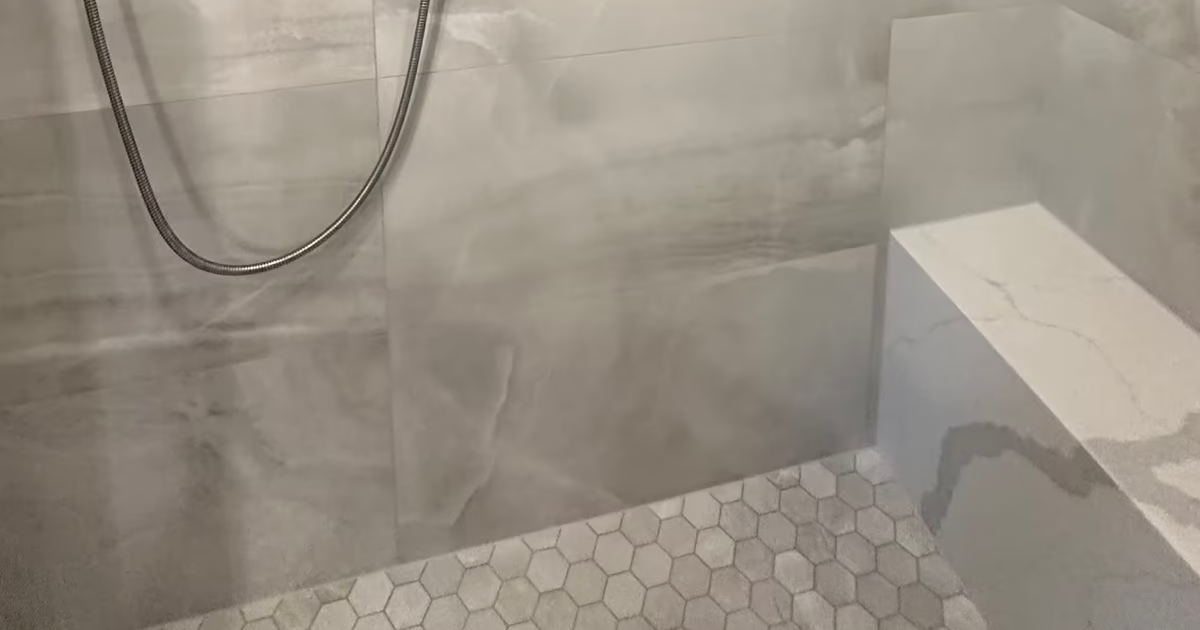
We build showers two ways. Our Essential tier is a correctly built shower with standard-format porcelain or ceramic tile, cement grout and metal or bullnose edge trims. Our Premium tier is large-format tile with 45-degree mitered outside corners, epoxy grout, and premium-brand setting materials such as LATICRETE. The common assumption is that the cheaper one is waterproofed less carefully. It is not. Here is what is the same in both, what differs, why the differences cost more, and who should pay for them.
What both tiers share, and where they split
The tier changes the surface, not the shower underneath. The parts that keep water out of your framing are set by code and industry standards, and on every shower we build they are company practice regardless of tier:
- A code-listed waterproofing membrane. The model residential code requires the walls and floor framing around a built-up shower to be lined, lists sheet-applied and liquid-applied membranes meeting ANSI A118.10 among the approved materials, and runs the lining at least 2 inches above the finished threshold. Tile does none of this work; see Tile and Grout Are Not Waterproofing.
- A sloped base. The same section requires the finished floor to slope toward the drain at 1/4 to 1/2 unit per 12. Whether that is a mortar bed or a foam tray depends on the job, not the tier.
- A flood test before tile. The code's liner test is 2 inches of water at the threshold for at least 15 minutes with no evidence of leakage.
- Flexible sealant at changes of plane. Under the TCNA Handbook's Method EJ171, the industry standard, inside corners on interior work get a flexible sealant meeting ASTM C920 instead of grout, and these joints are required in residential work too.
- Permits and inspections as the address requires. Denver, Aurora, Parker and the rest of the metro do not all follow the same rules.
A "basic" package that skips any of these is not a basic shower; it is one that will leak. The tiers part ways at the surface:
| Element | Essential | Premium | Why Premium costs more |
|---|---|---|---|
| Membrane, sloped base, flood test, ASTM C920 sealant | Yes | Yes | No difference |
| Wall tile | Standard-format porcelain or ceramic | Large-format porcelain (24x48 and similar) | Flatter wall, heavier mortar, back-buttering, leveling clips, 95% coverage |
| Outside corners and niche edges | Metal profile or bullnose trim | 45-degree miters, ground and polished by hand | Fabrication time on every edge |
| Grout | Cementitious | Epoxy (ANSI A118.3) | Material cost, short working time, strict cleanup, longer cure |
| Setting materials | Standard-brand products | Premium brands such as LATICRETE | Material cost |
| Linear drain, bench, glass, steam, heated floor, curbless entry | Optional | Optional | Each adds its own labor and materials |
Large-format tile: the wall costs more before the tile goes on
A 24x48 porcelain tile does not follow the wall; it bridges it. Fine Homebuilding's large-format guide gives the flatness target as 1/8 inch in 10 feet and 1/16 inch in 24 inches, tighter than a wall framed for drywall usually is, in our experience. Meeting it means correcting studs or building out the board before any tile goes up: labor you will never see in the finished shower.
Setting changes too. The same guide says that with larger tiles "you must always back-butter," using a bigger notched trowel and a slightly deeper bed to make room for leveling clips. Custom Building Products' large-format mortar page requires mortar coverage of at least 95 percent in wet areas. Reaching that on a 2-by-4-foot tile takes a large-format mortar (bags marked ANSI A118.15), more of it and more time per piece, and leveling clips then hold each tile flush while it cures. The details are in Why 24x48 Porcelain Tile Requires Better Wall Preparation.
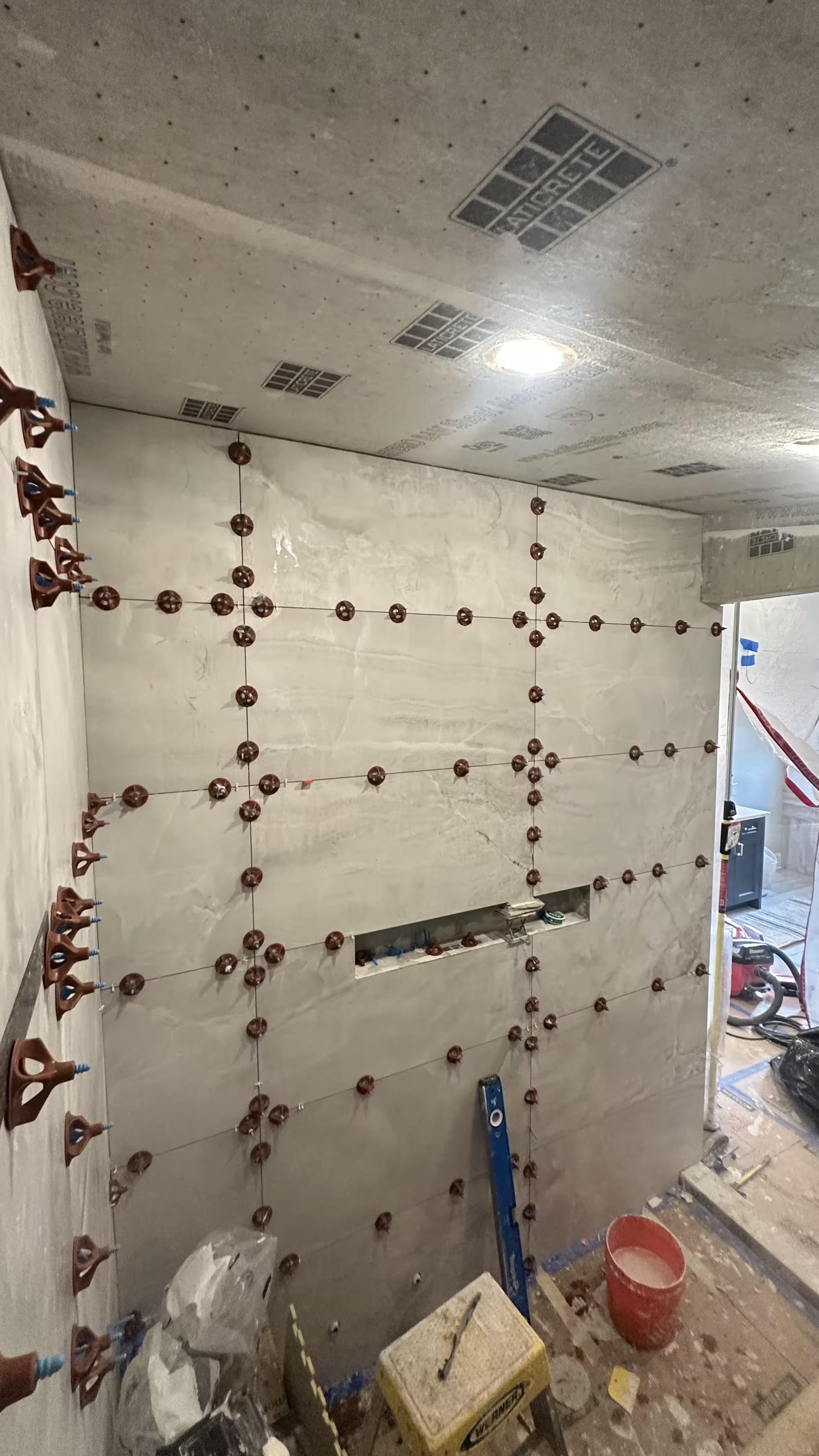
What you get for it: fewer grout joints and a wall that reads as one surface. What you do not get is a more waterproof shower; the membrane behind it is the same. For the material itself, see Porcelain vs. Ceramic vs. Natural Stone for Shower Walls.
Mitered 45-degree corners vs. metal profiles
An outside corner, a niche opening or a bench edge exposes the cut side of the tile. The Essential answer is a profile such as Schluter's JOLLY (a flush 90-degree edge), RONDEC (a 1/4-inch rounded edge) or QUADEC (a square edge), or a bullnose piece where the tile line has one. Schluter's claim for each profile is that it "prevents tile edges from chipping." The anchoring leg sets in the mortar under the tile, and finishes include brass, aluminum and stainless.
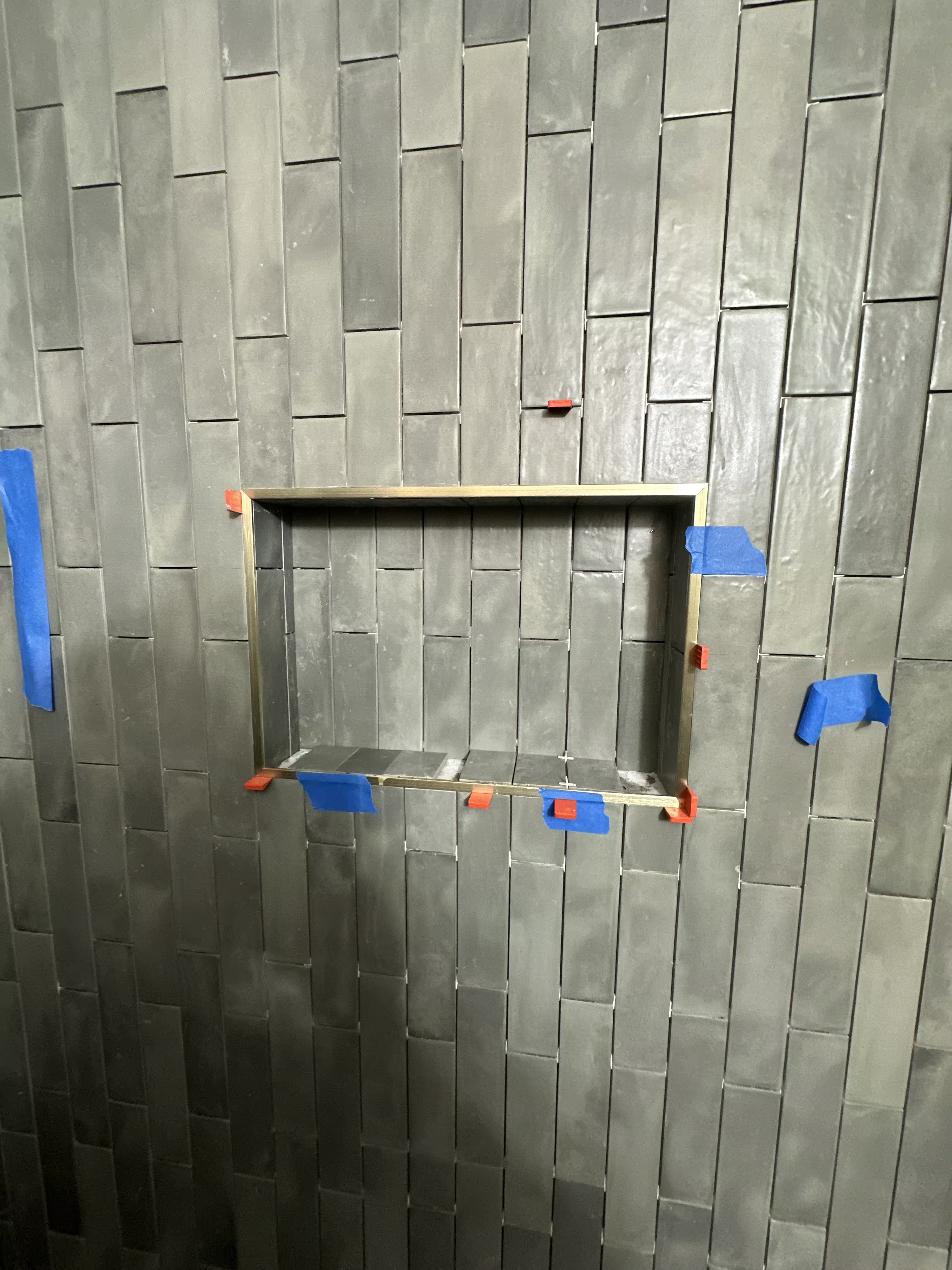
The Premium answer is to cut both tiles at 45 degrees so the porcelain wraps the corner with no metal. It is the detail people photograph, and the trade argues about it. In TileLetter's August 2025 pros-and-cons piece, one contractor cites "increased vulnerability to chipping" and warns that movement can crack the tile just beyond the miter; another says mitered edges "especially look great with large-format tile and panels" and hold up when done professionally over the right assembly, including a flexible ANSI A118.15 mortar. An earlier column is blunter: "Miter as the last resort," because a sharp edge in a shower is a safety concern and a very tight miter makes 95 percent coverage hard to reach.
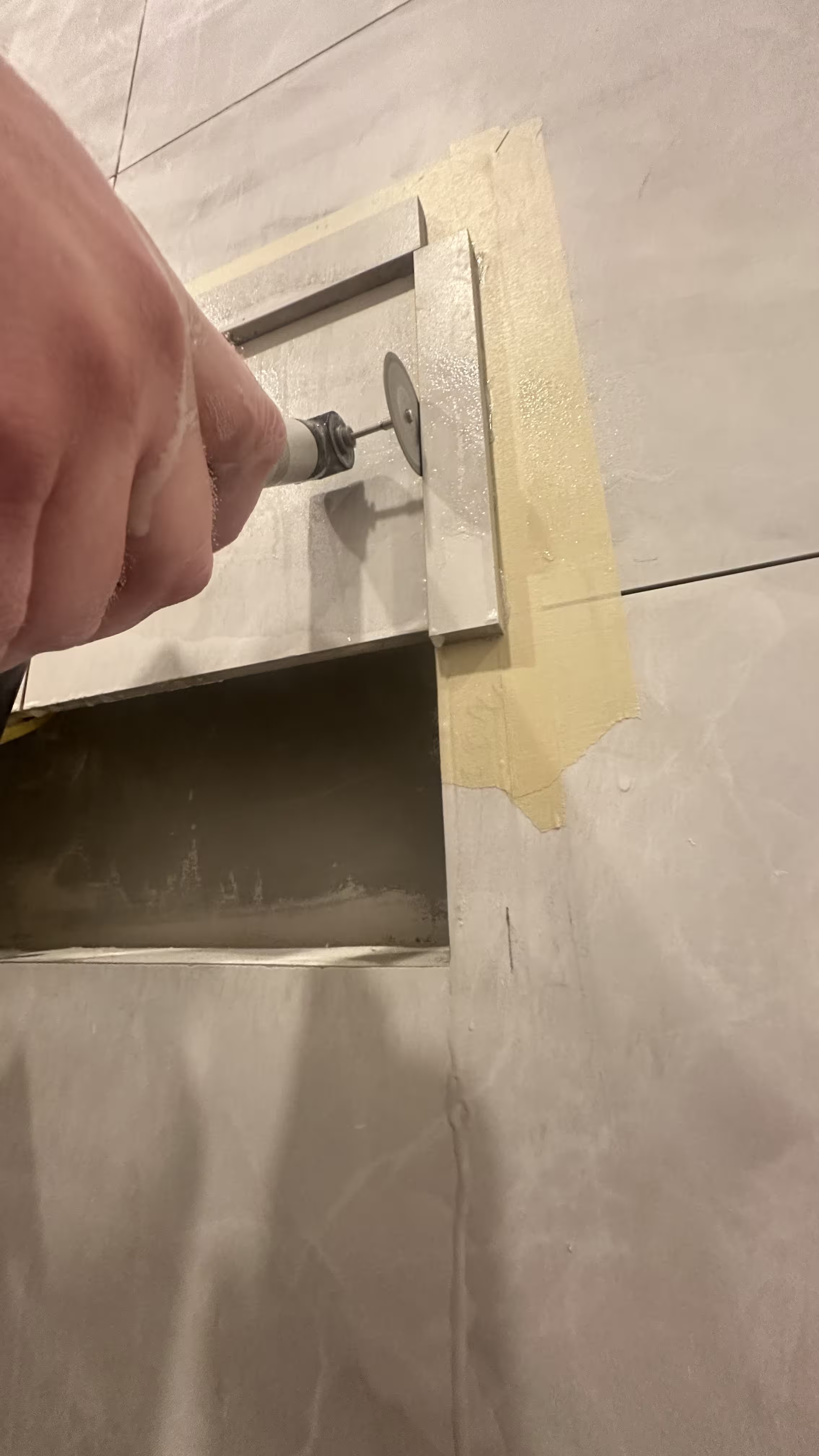
The cost is in the method. Fine Homebuilding's Joshua Oduin grinds miters by hand with a diamond blade because tile-saw blades "tend to deflect, especially on today's dense porcelain tiles" and chip the edge. He grinds slightly steeper than 45 degrees, stops short of a knife edge, and finishes sharp corners with a diamond hand pad. On our Denver steam shower, the niche and outside corner edges were cut at 45 degrees with a diamond blade, then wet-ground and polished by hand. A profile goes in far faster.
Epoxy grout vs. cementitious grout
Cement grout is the Essential standard. Fine Homebuilding's Tom Meehan calls it "cheap and easy to work with", and its residue can be buffed off the day after grouting. The trade-off is that cement-grouted joints need a sealer and epoxy-grouted joints do not.
Epoxy grout (ANSI A118.3) is what we use in the Premium tier, and it costs roughly two to three times as much as cement grout, depending on the brand. The data sheets say what that buys. LATICRETE's SPECTRALOCK PRO Premium data sheet claims it "never needs sealing," is stainproof to common household goods in residential use when spills are cleaned immediately, and is "cleanable to the original color." MAPEI's Kerapoxy CQ data sheet likewise lists no sealer required and high stain resistance with immediate cleaning. The same sheets explain the labor side:
- Short working time. SPECTRALOCK lists 80 minutes at 70°F and 30 minutes at 95°F; Kerapoxy CQ lists a 45 to 60 minute pot life.
- Strict cleanup. MAPEI says to clean the tile after each unit and do a final wash within 15 to 20 minutes, and warns the grout is "extremely difficult to remove once cured." Residue that hardens on the tile face becomes the problem covered in our article on epoxy grout removal.
- A longer cure. Both list full cure at 14 days. SPECTRALOCK reaches its stain resistance at 7 days and asks for 10 days before steam room use; Kerapoxy CQ asks for 10 to 14 days before water immersion. Your installer should give you the first-use date from the grout's data sheet.
- Not waterproofing. LATICRETE's sheet states that epoxy grout "is not a replacement for a waterproofing membrane." It is a better joint on top of the same membrane.
The full comparison is in Epoxy vs. Cementitious vs. Premixed Grout. Short version: epoxy earns its cost in a shower used daily by people who do not want to seal grout. It does not in a shower used twice a month.
Premium setting materials: what the data sheets claim
Our Premium tier uses premium-brand setting materials such as LATICRETE; the Essential tier uses standard-brand products carrying the ANSI listings the job needs. Three LATICRETE products show the difference. The claims below are the manufacturer's, not our test results:
- HYDRO BAN (membrane): a thin, load-bearing waterproofing and crack-isolation membrane exceeding ANSI A118.10 and A118.12, 0.020 to 0.030 inch thick when cured, needing no fabric in corners for gaps of 1/8 inch or less, and ready for a flood test in 2 hours at 70°F or warmer. We used it on every surface of our Denver steam shower: walls, sloped ceiling, bench and niche.
- 254 Platinum (thin-set): a one-step polymer-fortified mortar exceeding ANSI A118.4, A118.11 and A118.15, "ideal for thin porcelain tile and thin porcelain tile panels," with "ultimate adhesion for porcelain and glass tiles."
- 4-XLT (large-format mortar): exceeds ANSI A118.15, A118.4 and A118.11, non-sag on walls, and works from 3/32 inch up to 3/4 inch "without shrinkage," which covers the deeper bed large-format tile needs.
Two cautions. A standard-brand membrane that meets ANSI A118.10 is still a code-listed membrane, so the Essential shower is not built to a lesser standard. And a membrane, mortar and grout work as a system: the manufacturer's instructions govern, and site conditions, substrate, product compatibility and local jurisdiction can change the right product, so it is chosen job by job.
The add-ons: linear drains, benches, glass, steam, heat, curbless
Much of what people picture as a "premium shower" is a set of separate options, each with its own cost:
- Linear drain. Schluter's KERDI-LINE page gives the practical reason: floors "can be sloped on a single plane," which lets large-format tile go on the shower floor instead of mosaic. It also supports curbless layouts.
- Mitered niche. The same hand-ground edges on all four sides of the niche opening. A profile-trimmed niche, like the Commerce City one above, is the alternative.
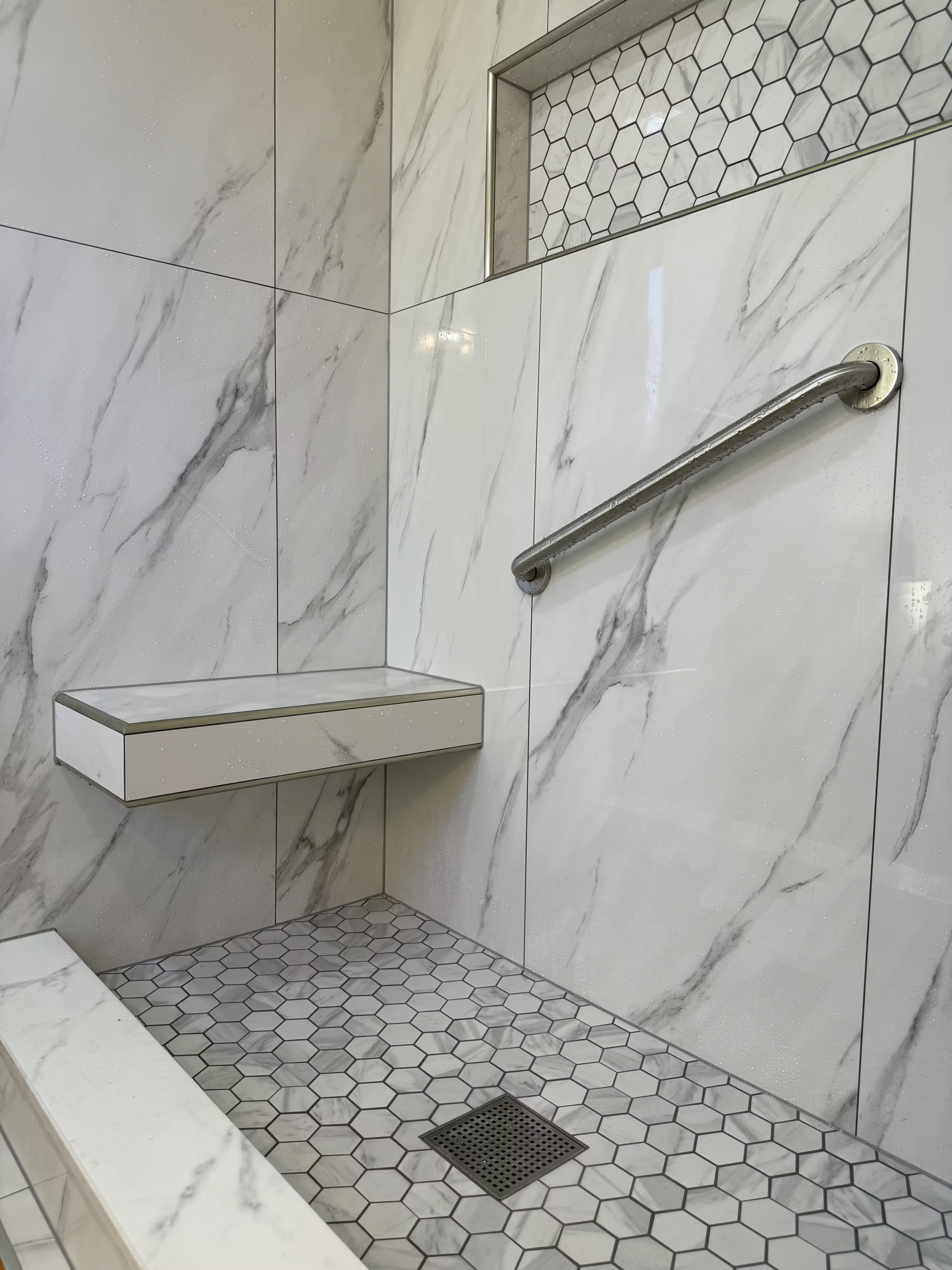
- Bench. Framed or floating, and waterproofed along with the walls. Our Highlands Ranch rebuild below has a floating bench.
- Frameless glass. Sized to the finished tile, so the walls and curb must be plumb and flat where it lands. On our Denver steam shower it landed on a tiled knee wall.
- Steam. Not a standard shower with a steam head added: every surface is waterproofed, the ceiling is sloped and tiled, and the glass runs to the ceiling. Our steam shower page walks through the Denver project shown here.
- Heated floor. An electric system under the bathroom floor tile; see Heated Bathroom Floors Under Tile.
- Curbless entry. Depends on the floor framing more than the budget; see Curbless vs. Low Curb vs. Standard Shower.
Who should pick which
Rental, flip or secondary bath: Essential
For a shower used by tenants, sold within a few years, or in a guest or kids' bath, Essential is usually the right call. Mitered porcelain rarely pays back there; a leak always costs. Spend on a tile you like, clean profiles at the corners and a good cement grout, over the same waterproofing. If a secondary bath sees daily use, ask about epoxy grout on its own.
Primary bath you will live with for fifteen years: Premium
Daily use for a decade or more changes the math. Fewer joints to clean, no sealing schedule and corners that read as one material are things you notice every morning, and the extra cost spread over those years is smaller than it looks on the quote. It is the tier we recommend for an owner-occupied primary bath being rebuilt once, properly.
Aging in place: either tier
Curbless entry, a bench, a handheld shower and blocking for grab bars are planning decisions, not tier decisions, and they have to be framed before the membrane goes on. Our Highlands Ranch rebuild paired large-format tile with a grab bar and a floating bench.
Upgrades that are not worth it
We would rather talk you out of an upgrade than install one you will not benefit from:
- Epoxy grout in a rarely used guest shower. You pay for stain resistance that a shower used a few times a month never tests, plus the stricter installation.
- Mitered corners on small-format tile. With joints every few inches, a seamless corner does not read as slab, and the edge is just as exposed. A profile suits small tile.
- Large-format tile on a wall that cannot be flattened. If the framing cannot reach 1/8 inch in 10 feet within the budget, a 24x48 is likely to show uneven edges in raking light. A smaller tile on a well-prepared wall looks better.
- A linear drain under a mosaic floor in a curbed shower. Its payoffs are a single-plane slope for large-format floor tile and curbless entries. Behind a curb with mosaic, a standard center drain does the job.
- Premium-brand materials mixed at random. Paying for one manufacturer's membrane and then setting tile with unrelated mortar and grout gives up the reason to buy into a system.
- Steam without a sealed enclosure. Without glass to the ceiling, the steam goes into the rest of the bathroom.
Not sure which tier fits your bathroom? Ask us to price both. Either way you get the same membrane, sloped base and flood test, an itemized estimate, and a straight answer on which upgrades will not pay off in your house.
Frequently asked questions
Is the Essential shower waterproofed as well as the Premium one?
Yes. Both get a code-listed membrane, a sloped base, a flood test before tile and ASTM C920 sealant at the changes of plane. The membrane brand may differ; the standard it meets and the test it passes do not.
Can I combine elements of both tiers?
Technically, yes: nothing about epoxy grout requires large-format tile, and large-format tile can be finished with profiles instead of miters. Standard-format tile with epoxy grout is one way to get low-maintenance joints without the large-format wall prep. Ask us to price the combination you want.
How much more does Premium cost?
It depends on the shower's size, the tile, how many edges are mitered and which options you add, so we quote it per project rather than as a percentage. For a tub-to-shower conversion, the tier is one of the things that moves the price within the range shown above. The other drivers are in what affects bathroom remodeling costs in Denver.
Will mitered corners chip?
They can. A mitered porcelain edge has no metal protecting it, which both the trade press and the profile makers point out. Solid support behind the edge and a polished rather than knife-sharp edge reduce the risk, but if a chip would bother you more than a visible trim line, choose a profile and we will install it without argument.
Sources and notes
- 2021 International Residential Code, Section P2709 Shower Receptors (UpCodes, Colorado edition) — lining required; sheet-applied and liquid-applied membranes meeting ANSI A118.10 are listed materials (P2709.2.4); lining extends not less than 2 inches above the finished threshold; finished floor slopes 1/4 to 1/2 unit per 12 toward the drain.
- 2021 International Residential Code, Section P2503.6 Shower Liner Test (UpCodes) — completed liner filled with water to not less than 2 inches at the threshold and retained for not less than 15 minutes with no evidence of leakage.
- NTCA Technical Team, 'Flexible caulk versus a non-flexible grout', TileLetter, March 1, 2021 — movement joints are needed at changes of plane, including inside corners on interior work; TCNA Handbook Method EJ171; the best material is a flexible sealant meeting ASTM C920.
- Scott Carothers, 'The critical importance of movement joints in tile work', TileLetter, May 1, 2023 — interior change of plane: movement joints required at all inside corners; sealant to meet ASTM C920; movement joints are required in residential work.
- Robin Nicholas and Michael Schweit, 'Large-Format Tiles', Fine Homebuilding Project Guide: Tiling — substrate flatness of 1/8 inch in 10 feet and 1/16 inch in 24 inches; 'with larger tiles, you must always back-butter'; bigger notched trowel; leveling clips need a 1/16 to 1/8 inch deeper bed.
- Custom Building Products: ProLite Premium Large Format Tile Mortar — exceeds ANSI A118.15HET; non-sag, medium bed up to 3/4 inch; mortar coverage required to be at least 80 percent in dry areas and 95 percent in wet areas.
- LATICRETE: HYDRO BAN (product page) — manufacturer claims: thin, load-bearing waterproofing and crack-isolation membrane exceeding ANSI A118.10 and A118.12; 0.020 to 0.030 inch cured; no fabric needed in corners for gaps of 1/8 inch or less; flood test allowed in 2 hours at 70°F or higher.
- LATICRETE: 254 Platinum (product page) — manufacturer claims: one-step polymer-fortified thin-set exceeding ANSI A118.4, A118.11 and A118.15; ISO 13007 C2TES2P1; 'ideal for thin porcelain tile and thin porcelain tile panels'; 'ultimate adhesion for porcelain and glass tiles'.
- LATICRETE: 4-XLT (product page) — manufacturer claims: exceeds ANSI A118.15, A118.4 and A118.11; non-sag wall installations; bonding mortar from 3/32 inch up to 3/4 inch without shrinkage.
- LATICRETE, SPECTRALOCK PRO Premium Grout data sheet DS-681.0 (rev. 0217) — epoxy grout meeting ANSI A118.3; 'never needs sealing'; stainproof to common household goods in residential installations, spills cleaned immediately; 'cleanable to the original color'; working time 80 minutes at 70°F, 30 minutes at 95°F; stain resistance at 7 days; full cure 14 days; 10 days before steam room or submerged use; 'not a replacement for a waterproofing membrane'. Older revision; data sheets change without notice.
- MAPEI, Kerapoxy CQ technical data sheet (dated 2026-05-04; copy hosted by BuildSite) — meets or exceeds ANSI A118.3; no sealer required; high stain resistance with immediate cleaning; pot life 45 to 60 minutes; clean tiles after each unit, final wash within 15 to 20 minutes; 'extremely difficult to remove once cured'; 10 to 14 days at 73°F before water immersion; full cure 14 days.
- Tom Meehan, 'Epoxy vs. Cement Grout', Fine Homebuilding issue 188 (2007) — Portland-cement grout is 'cheap and easy to work with' and its residue can be buffed off the day after; cement-grouted joints require sealer, epoxy-grouted joints do not; epoxy has a shorter working time, especially when warm; hardened epoxy is hard to remove.
- Robin Nicholas and Michael Schweit, 'Choosing Grout', Fine Homebuilding Project Guide: Tiling — epoxy grout costs, depending on the brand, about two to three times as much as cement grout.
- TileLetter: 'Mitering tile and stone – Pros and cons', August 1, 2025 — Woody Sanders: 'increased vulnerability to chipping'; movement can crack the tile just beyond the miter. Pavlo Starykov: mitered edges 'especially look great with large-format tile and panels' and work 'when done professionally' over an assembly that includes a flexible mortar meeting ANSI A118.15. Profiles presented as the alternative.
- Mark Heinlein, 'Are tight miters the right miters for your project?', TileLetter, December 2, 2020 — sharp corners in showers 'can be safety hazards'; 'not easy to get 95% or better bond coat coverage' at a very tight miter; alternatives include beveled edges, bullnose and metal or plastic trim; 'Miter as the last resort'.
- Joshua Oduin, 'Mitered Joints Make a Tiled Shower Niche Shine', Fine Homebuilding (Kitchens & Baths 2018) — miters ground with a diamond blade because 'tile-saw blades tend to deflect, especially on today's dense porcelain tiles' and chip the edge; ground slightly steeper than 45 degrees, stopped short of a knife edge; cut surfaces and sharp corners finished with a diamond hand pad.
- Schluter-Systems: Schluter-JOLLY finishing and edge-protection profile — 90-degree profile for outside wall corners; 'prevents tile edges from chipping'; anchoring leg set in the mortar; brass, aluminum and stainless finishes.
- Schluter-Systems: Schluter-RONDEC finishing and edge-protection profile — rounded outer corner with a 1/4 inch radius; 'prevents tile edges from chipping'.
- Schluter-Systems: Schluter-QUADEC finishing and edge-protection profile — square outer corner; 'prevents tile edges from chipping'.
- Schluter-Systems: KERDI-LINE linear drain (product page) — 'floors can be sloped on a single plane to KERDI-LINE, enabling the use of large-format tiles'; supports curbless layouts.
- South Denver Tile Experts: Steam shower installation, Denver (project record) — large-format marble-look porcelain over HYDRO BAN on walls, sloped ceiling, bench and niche; leveling clips; niche and outside corner edges cut at 45 degrees, wet-ground and polished by hand; frameless glass on a tiled knee wall, floor to ceiling.
- South Denver Tile Experts: Shower remodel, Commerce City (project record) — standard rectangular green tile in a vertical stack bond; recessed niche finished with brushed metal edge trim; written, itemized quotes.
Code references are to the model International Residential Code (IRC). Denver, Aurora, Parker and other metro jurisdictions adopt different editions with local amendments, so confirm requirements with your building division before relying on them. Last reviewed October 26, 2026.